Sunday, April 17, 2016

Splitting and Shaking

Queens in cages, with attendants.
It's spring, and in a beekeeper's world, that means time to do some hive splitting, before they do it themselves. That's what has happened when you see swarms of bees on car fenders, or fences or wherever -- the hive is too full, the queen in the hive is getting old, so the bees hatch out a new queen and the majority of the hive's population breaks away to start a new one, once they find a place to live. It was a swarm that started us in this journey, and we get a bit excited when we hear about swarms, as long as they are not from our hives. Losing that many bees is never a good thing. That said we would never say no to someone who calls to tell us they have a swarm on their property and want us to gather it up!

The first thing we need to do making these splits, at least at this time of year, is make sure we have some new queens. Our queens this year are from Hawaii. Each one is in its own queen cage, along with a few assistants to take care of it. At one end of the cage is 'candy' for them to eat on the way, and we give them water by putting a few drops directly on the cage. They don't need a lot, but they still do need some. When we put them into the hives, we will take the plug out of the cage to allow the bees in the hive to eat their way in, while the attendants eat from the inside, trying to get the queen free. This teamwork and time allows the bees in the hive to acknowledge that they have a queen, and she becomes their main focus. They smell her pheromones and make a connection with her. If we just turned her loose in there, the other bees might not accept her, swarming her and killing as they believe she could be an intruder.

Dropping the Queen cage into the hive.
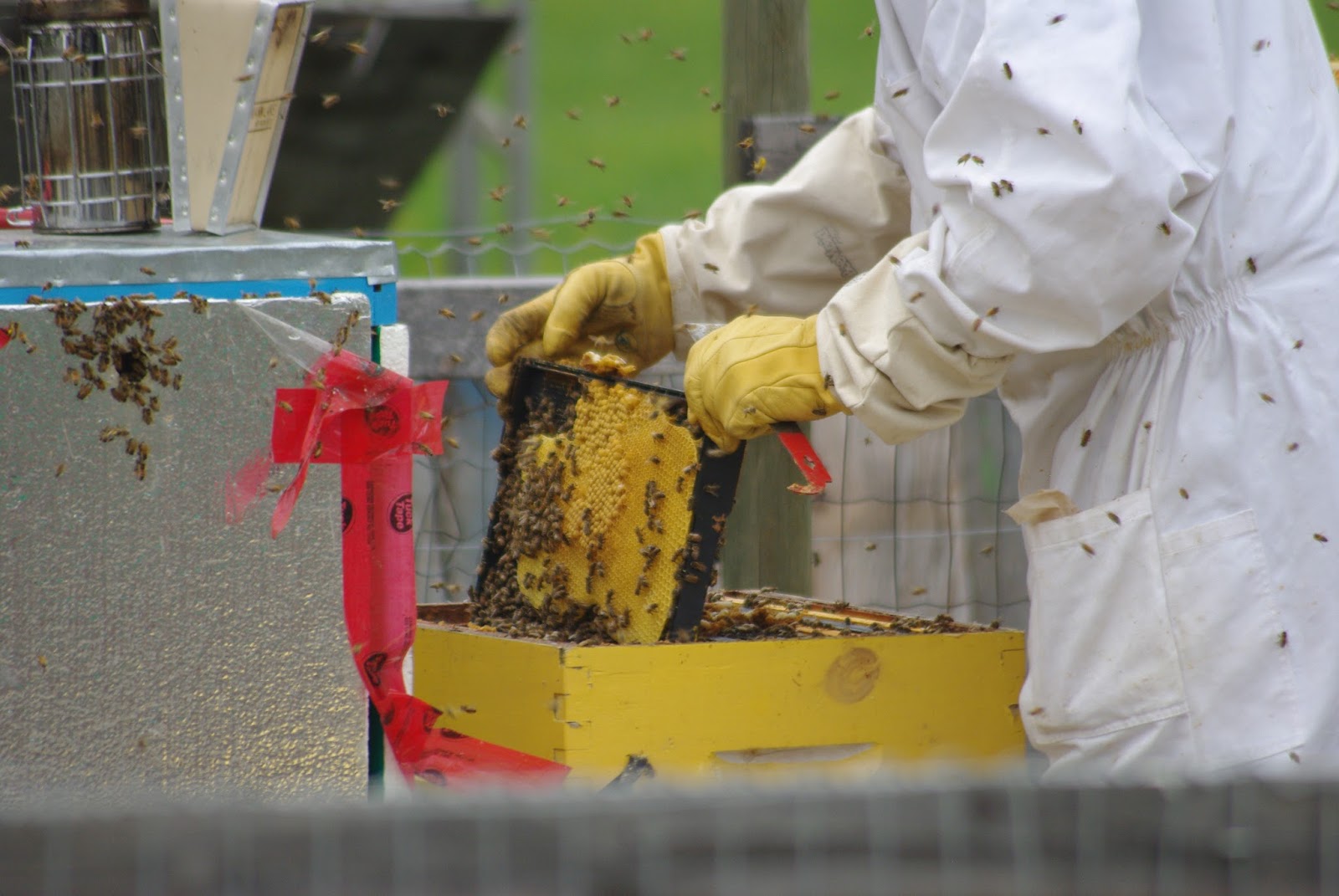
Before we add any queens, though, we have to prepare the hives, and split them. Each hive will already have a queen in it, and since we can't have two queens in a hive, we need to know where she is. To do this, we remove all the bees from the top box, brushing or shaking them off the frames, into the bottom box. If the queen is among them, she will also then be removed into the bottom box. Ideally we do this in the heat of the day, while the foraging bees are out working. Once the bees are all in the bottom box, we take some frames with brood out and move them into the top box. This will make the nurse bees want to be up there with them. We put in a 'queen excluder' -- a screen that allows the bees to go through but not the larger queen -- so that when we go to take that box off in 24 hours, there is a group of nurse bees, larva and eggs, all up there. That will be the basis of the new hive. We remove that box, set it up as the base unit on a new hive, drop in the queen, and we have our split complete.

The queen excluder.
Sounds easy, right? It probably would be, but then again, you have to remember we are dealing with some -- okay, millions of -- very protective, very determined little ladies here. We also have to check the hives before we do anything. We need to make sure they haven't started creating queen cells on their own -- a sign that they were getting ready to swarm. If they have, we may be able to use one of their own queens to start yet another hive. We don't want to add a queen to any new queen cells that are about to open. We also want to make sure the hive is healthy; there is no point dropping a new queen into a hive that is not going to survive. These are queens from Hawaii. They don't come cheap.

'Shaking' the frames. You can see the honey spraying off it.
When the splits are complete, we need to provide for the bees in the new hives for a few days. If we didn't, without foraging bees (because they would fly back to their original hive), the nurse bees would have nothing to live on, so syrup is a requirement at this point. When we did the splits, we also gave them some capped honey and pollen on the frames from the old hives, so they will be fine for a couple days while they all adjust and new bees hatch. Those new bees will soon be able to forage and the hive will thrive. We then will load up those new hives and take them to a new location; we will do this because these new hives will be a bit weaker and if conditions change, they could be overpowered by stronger bees from the original hives coming in and stealing from them. Our hives will be heading north about half an hour, where they will be able to help pollinate some fruit trees. Moving them also should mean that if something happens to harm the hives here again this year, as happened last year, we still have some bees to build from.

The queen excluder in place. The top box will sit on top it.
The bees that stay here will be unaffected by the change. They currently have plums, peaches, crabapples, pears, nectarines and apples all in bloom. The dandelions are out in abundance. The flowers are breaking through in the garden, and the holly trees are, apparently, abuzz with bees as they start to bloom. We have lots of drone cells in our hives, and they are all in good shape. The bee year is well underway. Hopefully these are the first of many splits over the next few months, and we will see lots of honey in the fall.
Bees don't like being shaken and split, so more smoke to calm them. 

Really full hives, and lots of drone cells! 

More indicators that the hives are doing well, and are very full! 

'Bearding' on the front. They are agitated and overcrowded in the bottom box. 

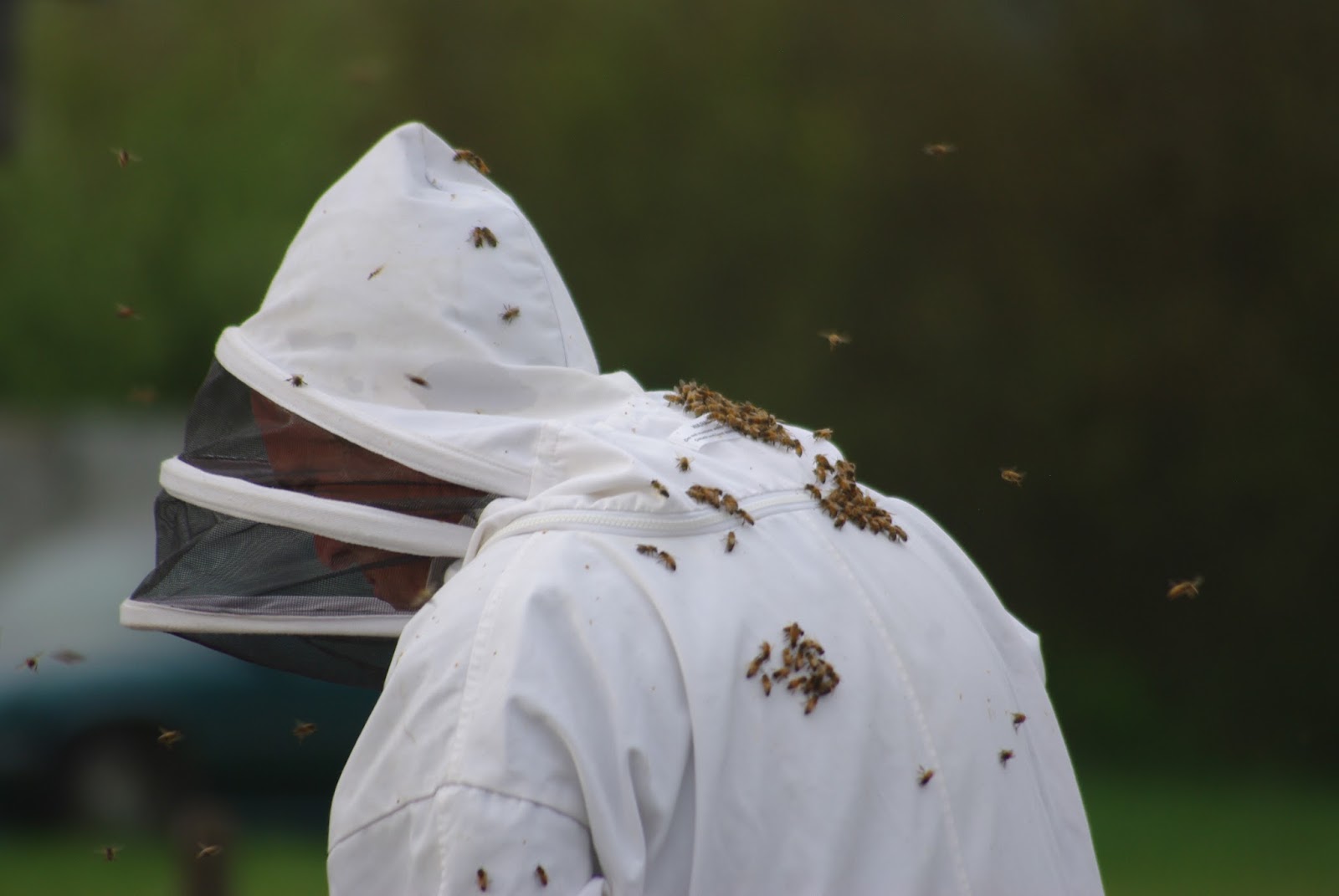
Yes, they even beard on us as we work. For this job, we want to wear full whites. 


Monday, March 28, 2016

Springing Forward

The swarm that started it all!
With the hope of ending 2016 a bit stronger than this last year (hopefully by tripling our hive count), this is the time of year when we have to do some planning. Of course, we plan the best way to split hives – there are a couple ways to do that. We plan the best strategy for watching out for and dealing with swarm cells, when the hives get too big and decide they want to make a new queen that will then take most of the young, strong bees to a new hive. Swarms are also a means for us to grow our yard, though, because when a swarm, either feral or from another bee yard does a surprise landing in some stranger’s back yard, we can go out and gather it up. It was a stray swarm landing in our yard four years ago that made us start this journey in the first place. We will be trying some ‘split hives’ where we put a divider right into the hive, like a bee condominium, with queens in each side. This allows them to keep the hive warm yet, and gives them a chance to get established without having to start completely from scratch. We will do a blog on this as we get into actually doing it.

Early hive activity 2016.
We have to plan on what purpose our bees will fulfill. They could strictly produce honey for us and this usually involves putting them into orchards and crops for the purpose of pollinating those crops. This is a very important part of having honey bees, and some would even argue that it is the only reason for having them. We could put pollen traps on the hives and gather the pollen for sale, because of the medicinal values. We could do likewise for propolis, which can be used in natural therapies. Some people raise bees simply in order to create more bees, breaking up the hives frequently and allowing those fragments to grow into full hives for sale, or for their own use. Queen rearing is a big business, and takes a special skill, because the queen cells are grafted into several dedicated frames, and are then caged and sold. There are even some apiasts who gather bee venom. Just about everything about bees can be used, so the options are many. Thankfully we don’t have to commit to just one thing, and can try our hand at several of them.

Another issue to make decisions on is where to put the primary bee yard. Right now, we have a small yard near the house, but if we are going to grow the number of hives, we also have to grow the area, then make sure it will be safe from any rather unwelcome guests, including (but not limited to) skunks, racoons, and bears. Since we have been spending the last few days refencing the property, we have been able to give this problem a bit more consideration, and believe we finally have a spot picked out for it. The next step will be to get it fenced and set up for moving the bees. Of course, not all of them will go to one spot in our yard. Hopefully we can find several other locations to set them out, allowing them to access more sources of pollen, and also to ensure that if something happens to one yard, we still have some bees to carry on with.

While it might be right that these plants are
protected from unwanted pests, they fail to
mention how deadly they are to pollinators.
Being avid gardeners at heart, we also need to consider what plants we want, and where we want them, to offer the best advantage to both the gardens and the bees. Some plants are just not what the bees want, while others can attract bees from miles away. Finding out which is which is a much more challenging undertaking than we thought it would be, because opinions differ greatly for many plants. Ideally we will avoid double-flowering plants – the ones that originally had just one layer of petals but now have been hybrid to the point of having two or even three layers of petals, making the flowers much fuller. By making them fluffier, it also makes them harder for the bees to find the pollen. We also must avoid any plants containing neonicotinoids. ‘Neonics’ are absolutely NOT bee friendly.


We also need to consider the flavors our plants will add to the honey. Some plants, like sunflowers, add no noticeable change to flavor but are an excellent source of pollen for bees (and the birds love the seeds all through the fall and winter). Others, like the blooms on the locust trees, add a wonderful flavor to the honey that is easily detected, and in some areas will add value to the finished product. We have a lot of locust trees on our property, and will soon have more, but we are also leaning toward planting more lavender. Alyssum, cosmos, and of course, dandelions are all plants that bees love, and that are vital to them. Planting some of these near the vegetable garden will ensure that all our plants are well pollinated and produce as much as possible – well, not the dandelions; the wind will take care of planting them all over the yard. It already looks like we are in for a bumper crop this year.


One of our bees on an apple blossom. 
The final consideration in choosing plants is blooming season. We want our bees to eat for as long as possible, but sometimes there are dry spells in a season where not much is happening, at least as far as flowers are concerned. Living in a rural community, we can count on the alfalfa and clover to provide for them throughout the summer and fall. We know that corn crops will do nothing, but berry crops will be wonderful in the spring. Of course, the orchards need bees, and our bees need fruit trees, so we have that one covered, at least for this year. We need to find plants, like primula, that will bloom early in the year, and some, like goldenrod, that bloom late. The value of the plants to the bees also will vary because of geographic location and anomalies, so it’s all a learning curve, but we’re more than happy to experiment to see what we like, and what our bees like.

It goes without saying that there are many more things to think about and plan for, like keeping the bees healthy, and the need for water, but at this time of year, these are the priorities in our bee yard.
BooBoo Bear was just a little guy last year, but even when little
these guys can do a lot of damage to a hive. 

Sunday, March 6, 2016

Pollen, Pollen Everywhere

  
Almond orchards in California
We are learning that pollen is often available, even when one wouldn't expect it to be about. That's what makes this an interesting time of year for bees. We receive a lot of questions regarding what happens with bees when they want to get out of the hive, but they have no place to get pollen. In large part, the answer to that depends on the local climate in general, and the day-to-day conditions. In some areas of North America, primarily California where almost 7 million tons of almonds are grown annually, the bees have been working for weeks already, pollinating almond trees, a substantial task, and a bit of a juggling act for beekeepers in the US. The need for the bees is massive, requiring bees to be shipped from one coast to the other in order to provide enough bees to do the job. The problem becomes ‘what do they do with them when almonds are done but nothing else is ready for pollination’. For bees from naturally colder climates, this is not a small problem.


Bee on pussy willow
However, we are blessed, especially this year, with our moderate winter and early spring. The bees, at least ours, are never totally locked away. They always have access to get outside the hive. On warmer days, they will go out to do their business – it can be a long time for them to keep their little bee legs crossed. Sometimes they take flight and realize too late that they underestimated the temperature, and we see a number of dead bees on the snow around the hives. They got too chilled to make it back. Some days, we see the results of their cleaning around their hives, where they have already started to remove those who didn’t make it through the winter.


When the bees start winter, they form a mass in the center of the bottom of the hive. They use their wings to keep the temperature constant and to create heat – hard work in very cold weather. Their only purpose is to keep the queen protected and alive, and they will keep their wings moving 24 hours a day to that end. They do not hibernate. As the winter progresses, the mass will move up the hive, dictated by the food they have stored away. They need to have enough depth of hive and enough food stores to last them through the entire winter. Once they get to the top, you know they have run out of food, and it becomes time to feed them, which we do every spring.

Female bloom on hazelnut tree.
So it’s early March in the Okanagan. This year, our snow is gone. The temperatures are above normal. The bees are out and about... and to our great surprise and greater joy, they are already bringing in pollen... a LOT of pollen. There are no flowers, no grasses, no crops. There are no leaves on any of the trees yet, although the leaf buds are definitely swelling. So, where are they finding pollen?

Believe me, it’s there, but the flowers are so small, you really have to look for them. The first source for them is the wonderful, woolly pussy willows. Remember how, as kids, we would cut them and bring them in, the first true confirmation that winter has passed, spring was coming as promised, and life was going on? It’s understandable, but please remember, these little fluff balls are critical to bees early in the season, so leave some for them. This is the source of the deep yellow pollen they are packing into our hives right now.

Female hazelnut flower with male catkin in background

The second source would be hazelnut trees. Most people never notice the blooms on them... they are early in the year, when people aren’t looking for blooms on anything, but they are there. The hazelnut tree has both male and female flowers, the female being a very small star-like purple flower on the end of the bud. Hanging around these little ladies are long, thick catkin, about 8 inches long. In reality, the tree is NOT pollinated by bees at all. The plant is designed so that the wind does all the work, but there is so much pollen on the male catkins, that it is a true feast for the bees. The bees have absolutely nothing to do with the small, delicate female flowers. The catkins would be the source for the paler yellow pollen being stored away in our hives.


Hazelnut tree with catkins evident. 
Our search isn’t done. Today we saw they are bringing in bright red pollen. The search is on to find the source of that! The top of our suspect list is the weeping willow. 

Monday, February 8, 2016

Time Sure Flies


2015 New Zealand new hive package Queen cage and comb
It’s been almost a full year! How did that happen? Our last blog was about the Flow Hive, and we start this season off with, yes, you guessed it, a real Flow Hive of our own. It's only one of the new developments from the last 12 months, and to be honest, we are more than ready to leave 2015 behind and start 2016 with a bang. We can’t wait to get our Flow Hive out there and full of bees, and we can't wait to include updates about the hive in our blog, so come on, Spring! Time’s a-wasting.

Frame with Queen cells -- 23 of them -- not a good sign.

2015 was busy in many ways for us (which is why we never did any blogs). It was also, to say the least, a bit disappointing from the beekeeping perspective. The year started off wonderfully, with all our hives coming through the winter with flying colors. We were thrilled to see all those bees in all those boxes. The Queens seemed strong, the hives were busy and everything seemed wonderful in our little bee world. We set a couple of hives in a new yard (thankfully) and prepared for a year of growth, success, and lots of honey. Unfortunately, the best laid plans of mice and men...

The new motorized 20-frame extractor!
Though we started off strong with all our hives, and we added three new package hives from New Zealand, and three new local nucs to the mix, we ended up the year with one less hive than when we started. These were definitely not the results we had hoped for, but it was better than it could have been. The new packages started off well enough and grew steadily enough, that we purchased more boxes, more equipment and, thankfully, a new motorized extractor that didn’t have to be hand-cranked! Soon into the spring, though, our bees faltered. The new hives didn’t grow. The queens were laying in spotty patterns – not a good sign. We found hives with dozens of new emergency Queen cells, indicating that the hive was in a panic to create a new queen -- the current one was either sick or dead. We had many bees dying, their tongues protruding as if they were poisoned. In fact, we assumed that they must have gotten into a sprayed crop and brought the poison back with them, but the symptoms didn’t seem quite right. It was the start of a massive learning curve for us, as new beekeepers.

A week hive -- one of the new hives from New Zealand. 
We had the provincial Bee Inspector come around and he went through all our hives. The idea of it being Foul Brood was mentioned then ruled out (thank god, because the thought of burning our hives completely - the only treatment for the disease - was heart-breaking). Mites were also considered and tested for, but were ruled out. Samples were sent off to be tested, but the results were inconclusive. Through this, more of the hives faltered. We would split some because of massive queen production then find all queens had perished. It was a year of many challenges, and not much good news to share with anyone.

A weak frame with no production and few bees. 
Add to this the fact that we had a very dry year, not conducive to flowers blooming or plants growing well, and not really something that makes already-stressed bees happy. The bees were always looking for water, finding it too often in the swimming pool where they then became trapped. The drought also meant an increase in wasps, too many of which had a taste for new bee brood. We lost three hives completely to wasps – they came in, killed the already-struggling bees and robbed the brood.

A Queen cage, complete with Queen and attendants.

As we learn in life, though, failure begets knowledge. We learned many things over the course of the year. Among those things learned was that it was not a very good year for beekeepers in general around the continent. It was not a fact to celebrate, but it did reassure us that perhaps we weren’t the cause of our hives dying. We learned that spring in the apiary business means increased sensitivity to stings. We learned that in dry years, the honey will be less abundant but thicker in composition (thank god for the motorized extractor!). We have had the ultimate crash course on just about every disease known to bees, and every threat, and how to try to mitigate the damage they can cause. We tried a different treatment program (still organic) for the treatment of mites when we put the hives to bed for the winter. We will be trying some new techniques in the spring when the hives get ready to swarm, hopefully resulting in more hives for us in the end.


Mostly what we learned, though, is that we love being beekeepers, despite the challenges (and man, were there challenges in 2015!). Our first inspection this year went very well. The bees were in good clusters, and the hives we were sure would not last the winter seem to be going strong. We have put out feedings for them – another new recipe, as well as the pollen patties – and we are watching as they emerge on those first spring flights; they have waited a long time to go to the bathroom. It feels to be an early spring, with a new year of possibilities and potential (and hopefully a few less stings than last year, although we also learned some new, amazing tricks to deal with that as well). We have our new signs to up – hanging out our shingle, as it were – we have some new ideas and plans for our bees and their honey, and we’re ready to face 2016 head on. 

Saturday, February 28, 2015

Building a Better Bee Hive

 We’ve had a lot of people talking to us and sharing with us information about the Flow Hive! Thanks so much for that. This hive claims that we would be able to get honey from the hive without disturbing the bees. We have been more than curious about it, and hopefully in a few weeks will have a chance to view one for ourselves. We thought, though, that we would share some of our thoughts leading up to this, and share some of the things we will be looking for when we finally see this hive that has seemingly turned beekeeping on its ear.

First, one of the big jobs in tending hives is being able to check them to see what is going on inside. That means we need to pull frames, see if there are eggs and larvae at every stage, so we know the Queen is alive and well and doing what she should be doing. It also allows us to see if there are any new queen cells being formed – a sign that the hive could be getting big enough that it needs to swarm and start a new colony, or a sign that the Queen is in distress (or is gone) and needs to be replaced. We also want to be sure that there are no mites, parasites or other problems in the hive; we need to watch for these regularly so that if a problem develops, we can deal with it quickly. The only way to check on these things is to pull the frames and inspect them. Even with windows, you will not get a good view of the activities in the comb or the activity taking place on the inner frames, which so far in our experience has been where most of the action happens. Taking apart the Flow Hive to inspect, with spigots and other equipment there, could become much more labor intensive.

Our understanding at this point of the Flow Hive is that the frames are plastic, and they split open when you turn on the tap, so that the honey drains down and out the spigot. We’re not totally sure, though, how the bees will know that, with the cells capped, their honey has been taken away. The cap will still be there, intact, so the bees will have to learn how to tell when they are empty, and will have to remove the cap so they can then refill the comb. This may take away from their actual production of honey. An additional concern is the plastic frames themselves. Plastic can absorb what is around it, including pollutants and poisons. They will need to be replaced more often than our current frames require.

Another thing that we need to understand is the hive structure. We have two large bee boxes that house the bees and larvae. Both boxes are used for that, to keep the hive healthy and to ensure you always have a steady supply of new bees. When they start producing honey in the summer, they store that near the top of the hive, in what we call honey supers. In the Flow Hive, there are only two large boxes. That would mean they are using the second box for honey production instead of bee production. How does that impact the hive overall? When we remove the honey, we just remove the honey super, leaving the rest of the hive untouched, so we’re not really sure what the benefit would be.

It will be interesting as well to see how they deal with ants and other pests. Having honey outside the hive will be an invitation to wasps, ants and other critters we do not want trying to get into the hive. It also means that the honey is more accessible/tantalizing to skunks, bears, raccoons, etc. Do we have to remove and clean the spigots every time and does that require taking the boxes apart? How do we keep it all clean without having to break down the hive, which is the thing this hive is supposed to circumvent?

When we first saw the information about this hive, we were skeptical, to say the least. Information on the internet shows that it’s been around since about 2008, but has only gotten legs now. It was the subject of a huge crowd-sourcing effort of late and we honestly wondered if it was nothing more than a scam. That said, several well-known and reputable beekeepers have said they’ve seen it, and were impressed, so we will absolutely go into this with open minds. We’re excited about going to learn more about the hive in a few weeks. Hopefully our questions will be answered. Then the next issue will be if the cost of a Flow Hive, for anything more than a promotional/education tool or as a novelty, will pay off.


Now for a quick update on our own hives. We checked them a few days ago and gave all of them (except The White Outs and the Moody Blues) pollen patties. None of the hives had touched the sprinkled sugar plates we put in with them. We didn’t give pollen patties to the Moody Blues because we thought we had lost that hive. There was no activity in it at all. The White Outs missed out because, well, they had a few attitude problems when one of us (who shall remain nameless) mistakenly grabbed at the hive to pry off the lid and in the process slammed his hand over the upper opening... and about 300 bees. They will get their patty this weekend. On a more positive note, in the last few days, with warmer temperatures, we are seeing some activity around the Moody Blues, so maybe they were just really hunkered down because of the cold. We’re hoping so anyway. 

Sunday, February 8, 2015

Taking Care of Beesness

We have talked about what bees do in winter in Canada, but what about the beekeepers? How do they spend the winter? While it’s not all work, there are still some critical things that need to be done.

First, because we need to be ready for spring, we build bee boxes for new hives. We have some new bees coming next year, but we also have to be ready for the hives that might want to split up, getting some into new hives before they swarm and we lose them. We will be adding 5 new hives in the spring, 3 packages from New Zealand, and 2 local nucs. We’ve done our homework, and have some of the best, oldest strain of bees coming – who knew bees had pedigrees? They aren’t as detailed as the American Kennel Club, but there is definitely some advantage to knowing a bit of the history of your bees.

Squaring up the boxes.
To make sure we have enough for this year – the five new ones and whatever splits we may get from the ones we already have – we created 24 boxes, so 12 new hives. We don’t expect that we will fill them all, but we can dream. It’s assembly line work to make them, but with all hands working, they’re stacked and ready to roll. We’ve decided that each year will be assigned a color, so we can keep track of when they arrived. This year, will be The Motley Blue. Each hive is a different shade, so hopefully we will be able to tell them apart.

Another thing we do in the winter is learn more about our bees. We want to start raising our own queens, so we have been studying that process. Next year we should have a lot more honey, so we need to figure out where we can sell it and how to promote it. To that end, we have spent the winter discussing (okay, arguing) about a name for our apiary. Suggestions are welcome!

While thinking about what to do with the honey, we have also done some product testing at home – we need to have some fun, right? We’ve made some mead, using our own honey, our very pure wonderful, natural water, and our own fruit. We spray nothing, and are far enough removed from spraying that we are very comfortable with all our produce being organic. We have made some plain honey mead, some raspberry honey mead, some blackberry honey mead, and some peach honey mead. This year was just small batches, so we can see how it tastes before we do anything more. It is already bottled, and needs to sit like that for several months before it will be ready. We’re also trying our hand at some honey lager beer. No kits or store bought shortcuts, though. We used hops, malted barley, and honey, sparged our wort, and soon it will be heading to the carboys to finish up. It should be wonderful for the summer.

The Motley Blue

We have been planning on something to do to help our bees as far as gardening. You may remember that we were originally avid gardeners. Now we want to have plants that will complement and accommodate the bees. We’re thinking lavender and clover. We won’t be putting in five acres of either, but we may start with a few hundred plants, just to see how it goes. We also will be looking at adding some monarda (bee balm) for the little ladies, and hopefully they’ll like the herbs we keep every year.
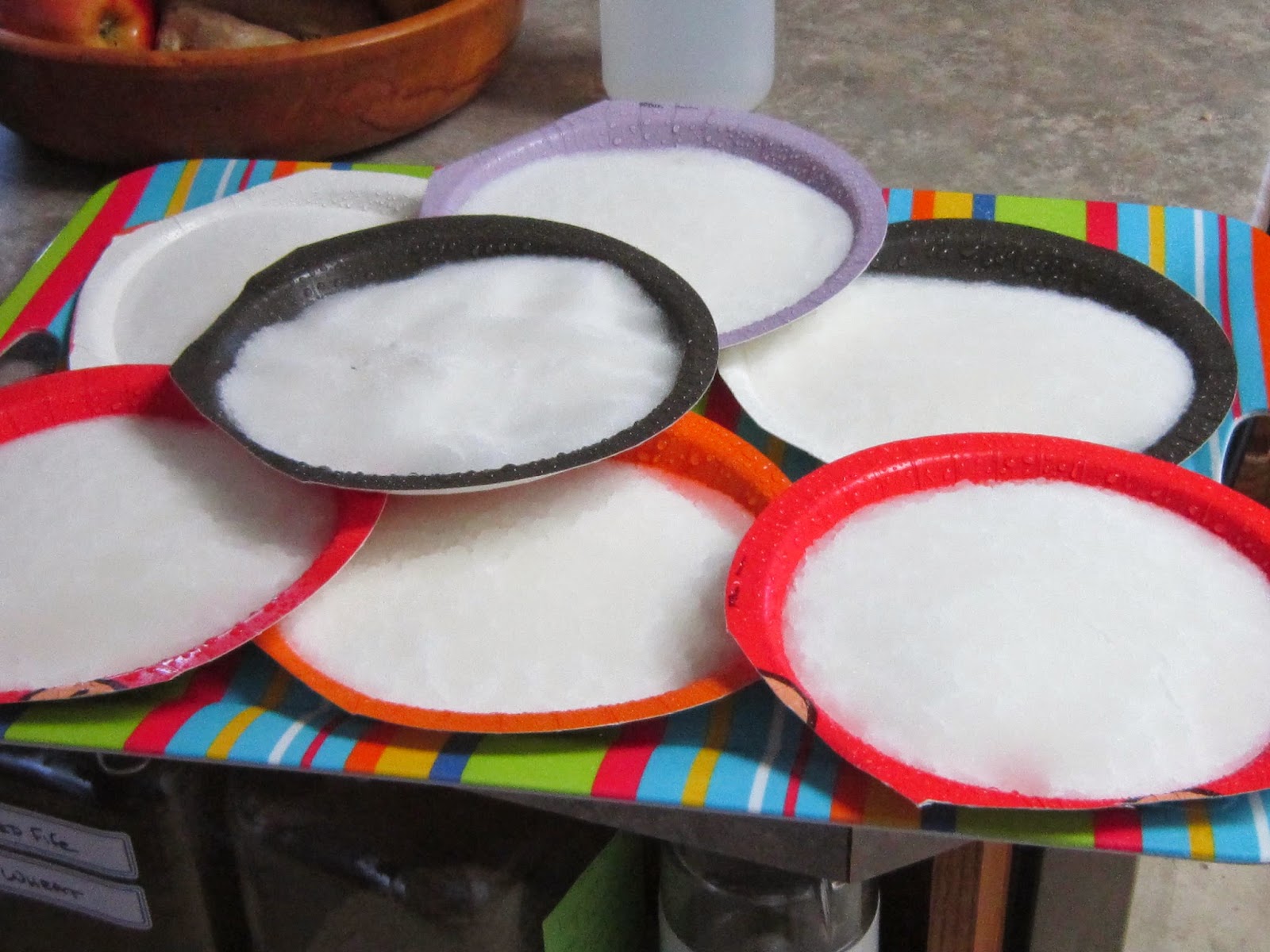
Plates of misted sugar.

We also still take care of the bees. This time of year can be tricky. They are starting to lay, starting to become active again, and their stored food could be growing sparse, so today we helped them out with plates of misted sugar – not sugar water, and not dry sugar, but misted so that it is sticky. If we had left it dry, they may think granules are dirt and set to work getting it out of there once the temperatures warm up some more. The sugar will also take on some of the humidity from the hive, and should hold them until temperatures are warm enough that we can put sugar water out for them. If course, once we reach summer, they don’t need us to give them anything in the hive; they want the entire inside for brood and honey. In a month from now, when we know that our temperatures are a bit more consistently warm, we will give them some protein patties, and let them get ready to bulk up and really get to work.

When we opened the hives today to put in the plates of misted sugar, we were able to see how our little bees were doing. They were very active today, flying around a lot. The Dregs, Gang Green and Pistachio were all doing well. There was some activity, and lots of bees taking flight. Moody Blue is a bit of a concern. We didn’t see any bees going in or out, and when we lifted it, there was very little activity. The White Outs, however, were crazy full and busy, creating comb and cleaning house. Because it is so full, the humidity is high and could be a problem. There was some mould around the edges, of the lid, so we cleaned out the doorways and hopefully they will get some air in there to dry it out a bit. Humidity is a much bigger problem than the cold is. Team Tangerine has been a concern for several months now, but it seems to be doing okay. It wasn’t nearly as full or active as the White Outs, but they are definitely holding their own. Mellow Yellow, as always, is going strong, lots of bees, lots of buzz, and hopefully this summer, lots of honey – barring issues again with humidity.
The White Outs! That's a LOT of bees! 

They're already going for the sugar. 

Mellow Yellow is also full to bursting. 

Giving sugar to the Gang Green.

Food for The Dregs. They're getting busy making honeycomb.
The Moody Blues. This one is a concern. We don't know where the bees have gone. 


Mellow Yellow has so many bees we had to push them aside to get the plate of sugar in there.