Showing posts with label new queen. Show all posts

Sunday, April 17, 2016

Splitting and Shaking

Queens in cages, with attendants.
It's spring, and in a beekeeper's world, that means time to do some hive splitting, before they do it themselves. That's what has happened when you see swarms of bees on car fenders, or fences or wherever -- the hive is too full, the queen in the hive is getting old, so the bees hatch out a new queen and the majority of the hive's population breaks away to start a new one, once they find a place to live. It was a swarm that started us in this journey, and we get a bit excited when we hear about swarms, as long as they are not from our hives. Losing that many bees is never a good thing. That said we would never say no to someone who calls to tell us they have a swarm on their property and want us to gather it up!

The first thing we need to do making these splits, at least at this time of year, is make sure we have some new queens. Our queens this year are from Hawaii. Each one is in its own queen cage, along with a few assistants to take care of it. At one end of the cage is 'candy' for them to eat on the way, and we give them water by putting a few drops directly on the cage. They don't need a lot, but they still do need some. When we put them into the hives, we will take the plug out of the cage to allow the bees in the hive to eat their way in, while the attendants eat from the inside, trying to get the queen free. This teamwork and time allows the bees in the hive to acknowledge that they have a queen, and she becomes their main focus. They smell her pheromones and make a connection with her. If we just turned her loose in there, the other bees might not accept her, swarming her and killing as they believe she could be an intruder.

Dropping the Queen cage into the hive.
Before we add any queens, though, we have to prepare the hives, and split them. Each hive will already have a queen in it, and since we can't have two queens in a hive, we need to know where she is. To do this, we remove all the bees from the top box, brushing or shaking them off the frames, into the bottom box. If the queen is among them, she will also then be removed into the bottom box. Ideally we do this in the heat of the day, while the foraging bees are out working. Once the bees are all in the bottom box, we take some frames with brood out and move them into the top box. This will make the nurse bees want to be up there with them. We put in a 'queen excluder' -- a screen that allows the bees to go through but not the larger queen -- so that when we go to take that box off in 24 hours, there is a group of nurse bees, larva and eggs, all up there. That will be the basis of the new hive. We remove that box, set it up as the base unit on a new hive, drop in the queen, and we have our split complete.

The queen excluder.
Sounds easy, right? It probably would be, but then again, you have to remember we are dealing with some -- okay, millions of -- very protective, very determined little ladies here. We also have to check the hives before we do anything. We need to make sure they haven't started creating queen cells on their own -- a sign that they were getting ready to swarm. If they have, we may be able to use one of their own queens to start yet another hive. We don't want to add a queen to any new queen cells that are about to open. We also want to make sure the hive is healthy; there is no point dropping a new queen into a hive that is not going to survive. These are queens from Hawaii. They don't come cheap.

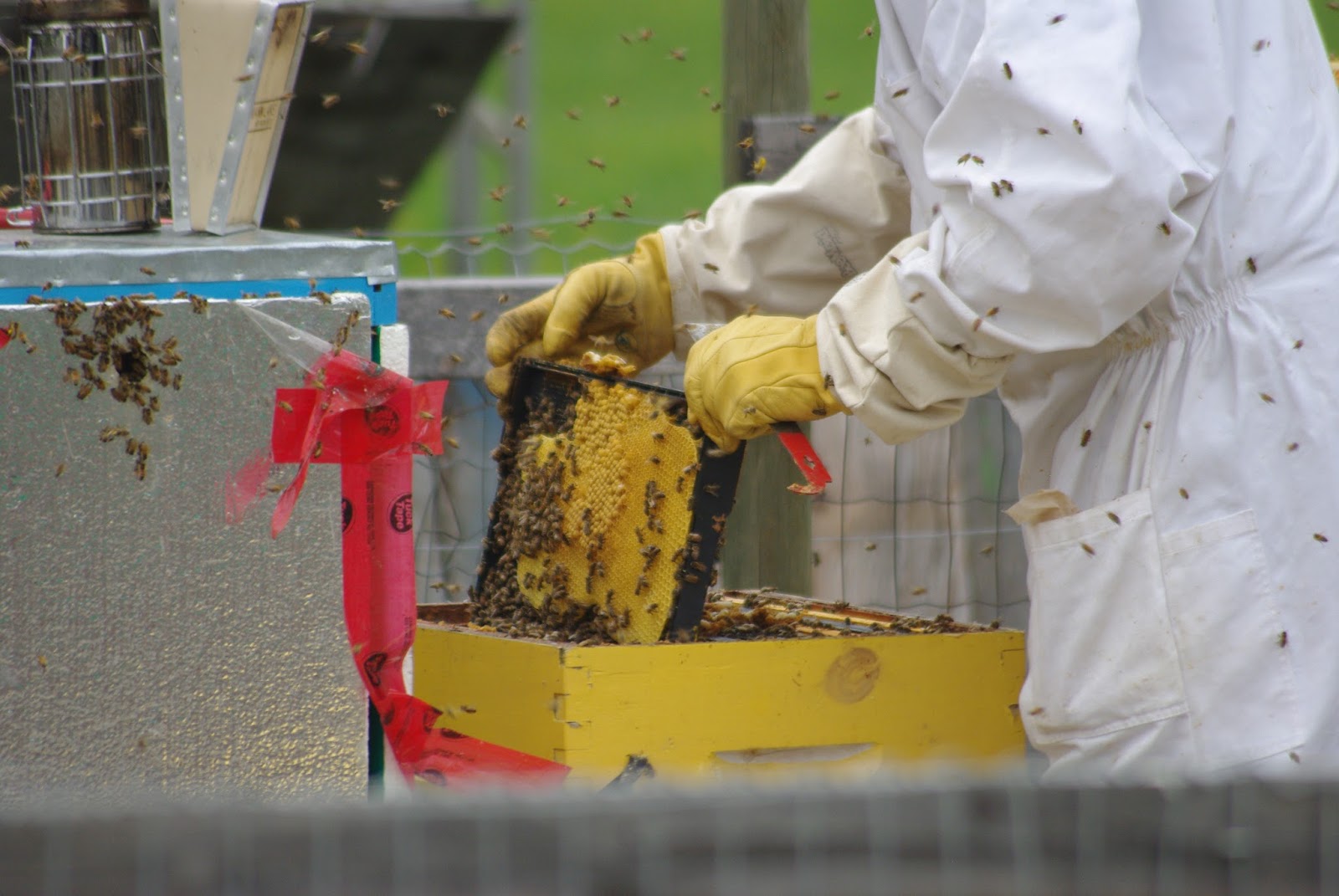
'Shaking' the frames. You can see the honey spraying off it.
When the splits are complete, we need to provide for the bees in the new hives for a few days. If we didn't, without foraging bees (because they would fly back to their original hive), the nurse bees would have nothing to live on, so syrup is a requirement at this point. When we did the splits, we also gave them some capped honey and pollen on the frames from the old hives, so they will be fine for a couple days while they all adjust and new bees hatch. Those new bees will soon be able to forage and the hive will thrive. We then will load up those new hives and take them to a new location; we will do this because these new hives will be a bit weaker and if conditions change, they could be overpowered by stronger bees from the original hives coming in and stealing from them. Our hives will be heading north about half an hour, where they will be able to help pollinate some fruit trees. Moving them also should mean that if something happens to harm the hives here again this year, as happened last year, we still have some bees to build from.

The queen excluder in place. The top box will sit on top it.
The bees that stay here will be unaffected by the change. They currently have plums, peaches, crabapples, pears, nectarines and apples all in bloom. The dandelions are out in abundance. The flowers are breaking through in the garden, and the holly trees are, apparently, abuzz with bees as they start to bloom. We have lots of drone cells in our hives, and they are all in good shape. The bee year is well underway. Hopefully these are the first of many splits over the next few months, and we will see lots of honey in the fall.
Bees don't like being shaken and split, so more smoke to calm them. 

Really full hives, and lots of drone cells! 

More indicators that the hives are doing well, and are very full! 

'Bearding' on the front. They are agitated and overcrowded in the bottom box. 

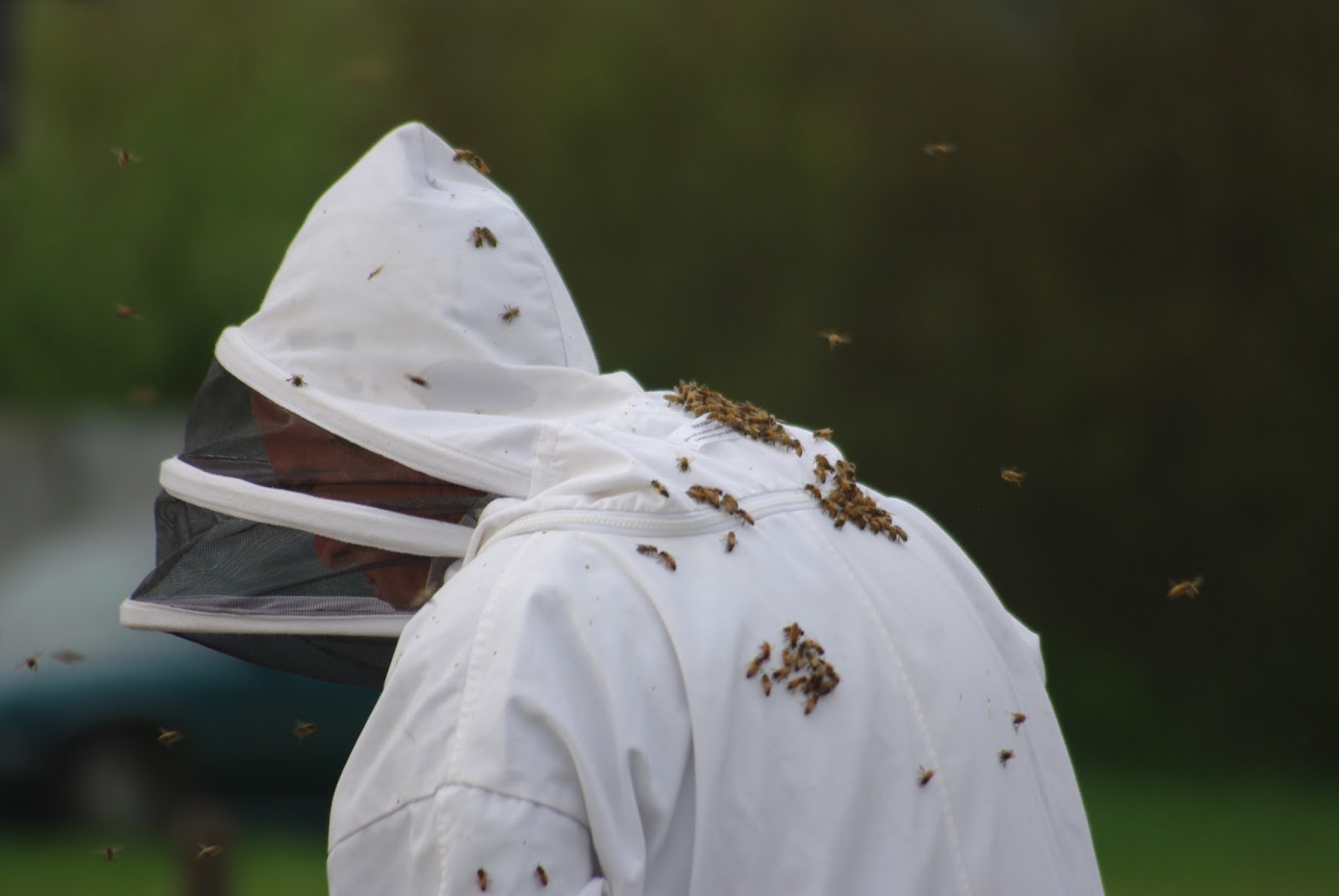
Yes, they even beard on us as we work. For this job, we want to wear full whites. 


Friday, June 27, 2014

Schrodinger's Bees?


The Dregs, sitting and chilling on their front porch.

It's been five days, and we just couldn't wait. Bees were coming, bees were going, which was good, but not enough to satisfy our curiosity. We needed to know what was going on inside The Dregs. This is the one problem with bees and beehives -- you can't see inside them without lifting the lid. Like the famous cat of Schrodinger fame, they could be alive or dead, but without looking in the box, we would never really know.


Lots of capped brood and Queen cells at the bottom.
Once everyone was suited up, that was exactly what we did -- and we could not beelieve what we saw! We were hoping that by taking uncapped brood from other hives, the new hive would be able to create some Queen cells so they would have the required egg-layer to keep the hive alive. Alive? That would be an understatement! They did create a Queen cell... then another... then another. Actually, we counted 27 Queen cells on the middle four frames, and they have been working on every frame in the hive. They also went through all their juice; it was bone dry. The Queen cells are distinctive because of their long shape and bigger size. Usually the brood cells are capped flush with the frame. Only one Queen will go on to rule the hive. When she comes out of her cell, she will chew through the other Queen cells and kill the growing Queens inside. The Queen in this hive will spend a lot of time chewing those other cells!

Textbook Queen cell on the bottom right end... the really long one!
So, now comes the new dilemma. Do we try to split it again, taking the three frames with Queen cells and putting them into a hive each, robbing some brood and eggs from the other hives, or do we not get greedy in the creation of new hives? We were more than content to end the year with 5, especially considering that we had only planned on 3 when we started out. We already are up one -- a bonus hive. Do we push our luck and see if we can take this year to establish the hives, then let them do their honey thing in full force next year? Looking out the window and seeing the rain, I can't imagine the bees will want to be doing much of anything in this cold, so perhaps letting them make a new hive or two might not be a bad idea after all.
More hired help. They will eventually get paid... in honey.
More Queen cells, these all over the frame. The bees will pick any cell that has an egg that is the right age when they don't have a Queen. 

Sunday, June 22, 2014

Splitsville!

Herbie the Wonderdog, in case you had to ask.
Well, it’s been a week. After the Moody Blues and White Outs got too cranky to have in the yard, taking their ire out on man (especially when mowing lawns) and beast (poor Herbie the Wonderdog does not like bee stings), we decided it was time to find them a permanent (for now, because that’s how we roll) location. Thankfully, the longest day of the year held promise for such a job.

On Saturday, a day that started at 6am, we cleared out the area where the bees would call home. We pounded in the posts, stretched the wire, covered the ground with crush, built the benches, and finally, at 9pm, we were ready to move the bees. Luckily for us, the Moody Blues and the White Outs had retired early (being cranky all day is probably tiring). We covered their doors and moved them to their new digs. Team Tangerine and Mellow Yellow, however, were more than content to sit on their front porch and visit. After all, it was the longest day of the year, and the evening was very pleasant. They were still visiting out there at 10 pm, and at 10:30 pm... Finally, being the old fogies that we are, we went to bed before the bees, promising to be up early again the next morning to move the last two hives.

Herbie (the twice bitten but still not shy) Wonderdog woke us at 5 am, apparently anxious for the rest of the bees to be gone. We could see that the Mellow Yellows were sleeping in (thankfully) but Team Tangerine was already starting to buzz. A few pieces of wood and some duct tape later, they too were on their way. We put pieces of wood in front of their porches so they would know that something was different so they would do some exploring flights, but some of those bees were just downright determined to stay in the yard, returning there and gathering where their hives used to be. Fortunately, the Pistachios, being the slowest of the hives, had been left in the yard, put in place of the Mellow Yellows. This was done in the event some of the bees wanted to return to their old home. A lot of them did, and are now calling Pistachio home, but that’s okay. It’s a simple and effective way to strengthen a weak hive.

We noticed though that there were a lot... seriously A LOT of bees returning to where Team Tangerine used to live, as well as some to where the other two hives used to be. What to do? The obvious thing to us was to take a new hive, pull a couple of frames with brood and eggs, and some uncapped larvae from the established hives, slip them into the new one, give them a feeder and some protein paddy, and put it where the stragglers were looking for their home. We now have 6 hives (if the new one creates a Queen)... we’ll call the new one The Dregs.

Having upset their routine so severely, we wanted to check on all the hives. Of course, it has to be the hottest day of the year... hotter than the hubs of hell, as my dear old daddy used to say. We opened up the bottom screens for all the hives, giving them some better air circulation. We opened up their doors, allowing more bees to go in and out. We were thrilled with one hive, disconcerted about another and a bit disappointed in the third. Suffice to say that none of the hives were thrilled to see us!

The Moody Blues had moved onto their first new frame. We took out the feeder, and we removed the protein paddy (okay, we left it out by accident but they weren’t eating it anyway). There were still five empty frames so we sprayed them with a bit of sugar water. We were hoping to see a bit more progress from them.

After closing up that hive, we were thrilled to see what was happening with the White Outs. They still had juice, but we pulled the feeder anyway to make some room for more frames They had five frames with both sides capped with brood! We scraped off the comb they had been making on the lid, because it too was filled with open brood, and put it in the second box. Yup, they had progressed enough that it was time to double their hive size!

Team Tangerine still had their drone frame empty. We removed their feeder because the entire top box was full of... honey! There was no brood there at all, so we decided it was time to give them their third box, a honey super. They can fill that baby with honey to their hearts’ content now. We took one of their top frames of capped honey and moved it to the new box we were starting. In their lower box they had very little capped larvae, but all frames were in use and new larvae, uncapped, was there, so the Queen is back on the job. That was a relief to see, because Queen transactions can be tricky.

Yes, that's honey... lots of honey just as it should be!
The Mellow Yellows have been working like troopers. They have had a honey super (third box) on the hive for a week, and they have already filled four frames with honey. On their second box, the outside frames were empty but the rest was very active with brood and honey. We took one frame of capped larvae to the new hive, and one frame of larvae and eggs. Hopefully the bees in the new hive will feed one of the new larvae lots of royal jelly and turn her into a Queen. They really are incredible animals.

Last was poor little Pistachio. The hive is still in the yard, gathering the stray bees from Mellow Yellow, and it was a busy place today. They still have three untouched frames, some capped brood and still have some juice. We opened the door, and will probably move them to the new area next week.


The Dregs was given a full feeder of juice. They will be a little bit of Mellow Yellow, a little bit of Team Tangerine, and tonight, when the Moody Blues and White Outs stray try to go to bed in their old location, we will have a cardboard box for them to sleep in. Once they are asleep, we will quietly move them into The Dregs as well, so they will have a home. Hopefully it works, but it will be a learning experience nonetheless, and could have the potential to create a new hive – a split (because it comes from pieces taken from already established hives). Welcome to Splitsville!


Angry bees -- for now.
Splitsville -- The Dregs, with all it's new bees.