Showing posts with label bee boxes. Show all posts

Wednesday, February 8, 2017

Keeping the Hive Alive

The hives in their new apiary. The snow is up to the top
of the benches they sit on (18" high) and the weatherman
is today calling for about another 12" to fall tonight and
tomorrow morning.
As we brace for yet another blast of snow (really, Mother Nature, enough is enough) it might be a good time to think about spring, from a bee’s perspective. We spend a lot of time making sure that our bees have the best preparation possible for winter, but in Canada, that season comes with a lot of variables, so in many ways, it can be a bit of a nail-biter. For us, it is very rare to still have these cold temperatures and snow falling. That is where we’re at right now – wondering if we gave them enough food, wondering if the weight of the hives was high enough to give them good odds of survival, etc. The one thing we do know is that when the temperatures are this cold, we cannot open up the hives to check on them. That blast of cold would definitely hurt them.

February last year, we were able to get into the hives.
In the fall, we closed the screens at the bottom of the hive, to help keep them warm. We treated the hives to make sure there were no mites in them – we want to make the viruses that come in on the mites do not get a chance to impact the brood that will carry the hive through the winter. We have made sure they have food in the hives. They also have stored honey and pollen which will become vital to them once the days start getting longer. That last brood of bees in the fall are ‘winter bees’. During the rest of the year, a worker bee lives about 6 weeks. Winter bees will carry the hive for up to 6 months. They have to be as strong as possible.

The worker bees from one of our hives forcing out a drone
last fall. The drones are much bigger, have much bigger eyes
and have no stinger.
Our bees should have already started laying new brood. They need pollen for protein primarily for the brood, so those stores are already being depleted. In the spring, once we can open the hives, we will be able to give them additional pollen, but right now, they are on their own. In the coldest months, they will be frugal in their use of stores, but once the queen starts laying brood again, the demand rises sharply. Remember that through those winter months, the worker bees keep the hive at a constant temperature (or as close to it as they possibly can) by rubbing their wings, or vibrating them, to create friction. They do this all day, every day, to protect the Queen.

An evicted drone. Notice the size of the eyes. 

Our queens now should be making worker bees. They will not create any drones until they are needed – in a bee’s world, men serve one purpose, and one purpose only; if it is not breeding season, the drones aren’t necessary, and come fall, the worker bees will make sure that every drone is kicked out of the hive. They are not feeding someone who does nothing to keep them all alive.


Making bee boxes... again. 
So, our bees are in their boxes, rubbing their wings, creating friction, eating very little. The brood is starting to be laid, so the queen is doing her thing. They cannot get out of the hive to forage. They also cannot get out of the hive to relieve themselves; there is no indoor plumbing in a bee’s world. On days when it warms up enough, they will leave the hive if for no other reason than to do that which they cannot do inside. Our bees have not had a possible ‘cleaning flight’ day for over three months, and this is definitely a concern to us. As winter drags on, they are thinking about one thing – providing for the hive the minute the temperatures are right. They need to have brood ready to take over, because those winter bees are getting tired. They need to have bees ready to forage, and they need more to take care of brood as the queen keeps producing. It’s all about keeping the hive alive. While some animals hibernate during the winter months, and other (like the wiener dogs) are sleeping in front of a warm fire, our bees are working like crazy in those little boxes.

Of course, they aren’t the only ones working in preparation for spring. We’re once again making bee boxes, making honey supers, putting together frames, and planning what to do with our bees and our honey this year. We’ll keep you posted on that. 

Sunday, February 8, 2015

Taking Care of Beesness

We have talked about what bees do in winter in Canada, but what about the beekeepers? How do they spend the winter? While it’s not all work, there are still some critical things that need to be done.

First, because we need to be ready for spring, we build bee boxes for new hives. We have some new bees coming next year, but we also have to be ready for the hives that might want to split up, getting some into new hives before they swarm and we lose them. We will be adding 5 new hives in the spring, 3 packages from New Zealand, and 2 local nucs. We’ve done our homework, and have some of the best, oldest strain of bees coming – who knew bees had pedigrees? They aren’t as detailed as the American Kennel Club, but there is definitely some advantage to knowing a bit of the history of your bees.

Squaring up the boxes.
To make sure we have enough for this year – the five new ones and whatever splits we may get from the ones we already have – we created 24 boxes, so 12 new hives. We don’t expect that we will fill them all, but we can dream. It’s assembly line work to make them, but with all hands working, they’re stacked and ready to roll. We’ve decided that each year will be assigned a color, so we can keep track of when they arrived. This year, will be The Motley Blue. Each hive is a different shade, so hopefully we will be able to tell them apart.

Another thing we do in the winter is learn more about our bees. We want to start raising our own queens, so we have been studying that process. Next year we should have a lot more honey, so we need to figure out where we can sell it and how to promote it. To that end, we have spent the winter discussing (okay, arguing) about a name for our apiary. Suggestions are welcome!

While thinking about what to do with the honey, we have also done some product testing at home – we need to have some fun, right? We’ve made some mead, using our own honey, our very pure wonderful, natural water, and our own fruit. We spray nothing, and are far enough removed from spraying that we are very comfortable with all our produce being organic. We have made some plain honey mead, some raspberry honey mead, some blackberry honey mead, and some peach honey mead. This year was just small batches, so we can see how it tastes before we do anything more. It is already bottled, and needs to sit like that for several months before it will be ready. We’re also trying our hand at some honey lager beer. No kits or store bought shortcuts, though. We used hops, malted barley, and honey, sparged our wort, and soon it will be heading to the carboys to finish up. It should be wonderful for the summer.

The Motley Blue

We have been planning on something to do to help our bees as far as gardening. You may remember that we were originally avid gardeners. Now we want to have plants that will complement and accommodate the bees. We’re thinking lavender and clover. We won’t be putting in five acres of either, but we may start with a few hundred plants, just to see how it goes. We also will be looking at adding some monarda (bee balm) for the little ladies, and hopefully they’ll like the herbs we keep every year.

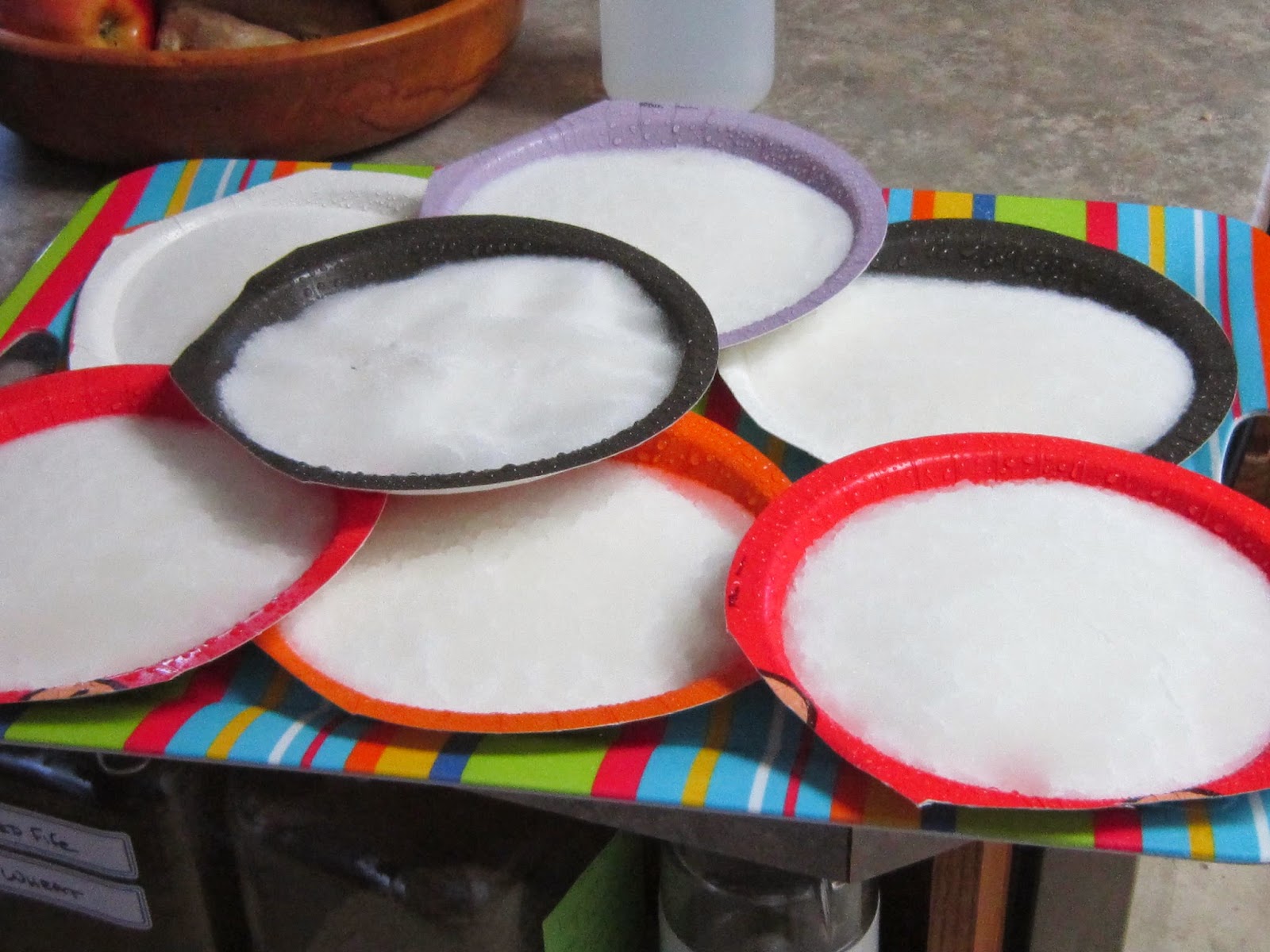
Plates of misted sugar.

We also still take care of the bees. This time of year can be tricky. They are starting to lay, starting to become active again, and their stored food could be growing sparse, so today we helped them out with plates of misted sugar – not sugar water, and not dry sugar, but misted so that it is sticky. If we had left it dry, they may think granules are dirt and set to work getting it out of there once the temperatures warm up some more. The sugar will also take on some of the humidity from the hive, and should hold them until temperatures are warm enough that we can put sugar water out for them. If course, once we reach summer, they don’t need us to give them anything in the hive; they want the entire inside for brood and honey. In a month from now, when we know that our temperatures are a bit more consistently warm, we will give them some protein patties, and let them get ready to bulk up and really get to work.

When we opened the hives today to put in the plates of misted sugar, we were able to see how our little bees were doing. They were very active today, flying around a lot. The Dregs, Gang Green and Pistachio were all doing well. There was some activity, and lots of bees taking flight. Moody Blue is a bit of a concern. We didn’t see any bees going in or out, and when we lifted it, there was very little activity. The White Outs, however, were crazy full and busy, creating comb and cleaning house. Because it is so full, the humidity is high and could be a problem. There was some mould around the edges, of the lid, so we cleaned out the doorways and hopefully they will get some air in there to dry it out a bit. Humidity is a much bigger problem than the cold is. Team Tangerine has been a concern for several months now, but it seems to be doing okay. It wasn’t nearly as full or active as the White Outs, but they are definitely holding their own. Mellow Yellow, as always, is going strong, lots of bees, lots of buzz, and hopefully this summer, lots of honey – barring issues again with humidity.
The White Outs! That's a LOT of bees! 

They're already going for the sugar. 

Mellow Yellow is also full to bursting. 

Giving sugar to the Gang Green.

Food for The Dregs. They're getting busy making honeycomb.
The Moody Blues. This one is a concern. We don't know where the bees have gone. 


Mellow Yellow has so many bees we had to push them aside to get the plate of sugar in there.