Showing posts with label swarms. Show all posts

Saturday, June 24, 2017

Swarm Chasers!

Swarm Chasers!

Swarm on a flower pot
It’s that time of year again… the beehives are bursting out all over the place, and we are out catching swarms. It’s a good time to remind people to please not panic if you see a swarm of bees. You know what I mean – the pictures of vehicles covered with bees, or a school bus fender hiding behind a massive beard of our little lovelies. When bees swarm, they are very docile – probably the most docile they will be in their lives – because they have a queen with them, and they have no brood or food stores or home to protect.

Craig called us to gather his swarm
A swarm is really just nature’s way of allowing a colony to reproduce. The bees, when they land in your yard and hang off a branch or fence, or as they were today, a plant pot, they are only there temporarily (unless the queen gets stuck somewhere, like in the back seat of a car). Their original home will be usually less than a quarter mile away, and they have stopped to re-orientate themselves as they head to their new home. Whether they have already decided where it will be and are sending scout bees out to it, or if they are there while scout bees hunt out a new viable home for them to move to, is still under discussion. What we do know is that they will move from their first landing point to their permanent home, usually in a couple hours.


Greg gathering a swarm in a juniper bush. 
If you watch them once they have landed and are bearded around their queen, you will see many of them shaking their abdomens (which could be considered their tails, in this case). That is their way of communicating with each other, but it also is how they send out pheromones to let other bees know where they are and where the queen is. This helps those scout bees find their way back to the swarm. They will move on, so please, if you can’t contact a beekeeper to gather them up, leave them alone for a few hours and they will eventually fly away. Don’t spray them with insecticide, or spray your plants around them. Instead, pour yourself a cup of coffee and watch; they are truly fascinating.


Sunday, July 17, 2016

Waxing Poetic

It’s been a busy summer so far, with very weird weather, but we finally found a few minutes to do a bee update!
Removing the partition from a Queen Castle to turn it into
one standard hive.
We have some results on our queen castles – the hives where we put three small nucs into one box. Two weeks ago we cracked them open to see how everyone was doing. On three of the castles, only one nuc per hive survived. On one of these nucs, we could see the queen had not hatched. On others, there were bees working but no queen laying eggs. Fortunately though, one nuc in each hive was thriving, so we just removed the partitions and turned them into regular hives with 10 frames each. This weekend, we checked those hives again and all but one are doing marvelously. We have even added a honey super to a one of them! Another of the castles, when we opened it, had all three nucs thriving. The bees are laying brood and bringing in honey, so next week we will be splitting them up into their own boxes.

Examining the brood pattern from one of our Kona Queen
Hives. Lots of bees and lots of capped brood!
We also have been seeing amazing results from our Kona Queens from Hawaii. The hives are bursting with bees, and are they producing honey! The three hives have produced more already this year than we had from all our hives the first year with the apiary. All of the ones in our yard now have 3 honey supers on them! For one of them, we have added a special honey super. Instead of giving them frames to store the honey, this one has round openings, about the size of hockey pucks, for them to fill with wax and honey. When we harvest, we simply pop the pucks out and put them in containers, selling the honey in the wax. It’s even healthier that way and a popular treat for many people. We’re excited to see them doing such a good job filling in the ‘Ross Rounds’ and will be looking at doing much more of this next year.

Building lots of burr comb on the lid of their hive.
Although it’s late in the year, with all the rainy and cool weather it seems the bees have gotten a bit discombobulated. We received a call this weekend about a swarm in someone’s yard. This is our fourth swarm to pick up this year – this one was big and about 20 feet up a pine tree. We managed to gather them though, and two days later these bees are doing orientation flights at the door of their hive already. The bees in this colony are very distinctive – they are much more yellow than ours, and have a lot more attitude.

Two of the other swarm hives are doing well, and in fact one of them now also has a super on them for honey. The last one unfortunately didn’t work out. We’re still very happy with the three new hives; they were a welcome bonus addition.

Inside the Flow Hives. Social media loves this hive.
Sadly, our bees don't. :(
The Flow Hive. *sigh* For some reason, our bees do not like the Flow Hive. We had it on a strong hive for over a month and that hive swarmed twice rather than go up into the Flow Hive. We moved it to another strong hive that had some partially full honey supers on it, but the bees would rather fill anything else, and are avoiding it completely. Next week, we will put it onto one of the hives with the Hawaiian queens, removing the full honey supers and giving them just this and a partially full super, and hopefully they will start to put something into it. It was easier getting them to do the work in the empty Ross Rounds with no frames at all than it is to go into the Flow Hive.

Checking a frame of brood. The bees were very active
this day, but the sun was shining so everyone was happy.
Our inspections have been rather spotty over the last month, because the weather has not been cooperating. They do not like to be opened when it’s cloudy – most of the bees are in there instead of out gathering pollen, so it’s full and they get a bit crabby. We cannot inspect hives when it’s windy or, obviously, when it’s raining, so it has limited us quite a bit on when we can see what they’re up to. The hives in the second yard are definitely in need of some TLC. That will happen next week. Also next week, 12 hives will be re-queened with new, local queen cells. Hopefully we will have nice weather, because they clearly did not like being checked today.

Messy, messy, messy! This is what happens when we forget
to give them something to build on!

We also pulled a frame from one of the hives two weeks ago. It was a mess! We had miscounted the frames when we closed it up, giving them 9 instead of 10. The result was that the bees decided to be creative, filling in the extra space themselves. One of the Queen Castles, as well, was missing a frame. They built their own, attaching it to the roof of the hive and filling it with honey and brood. I suppose, in the bee world, it’s a work of art, but I would rather see them putting that sort of energy into filling more Ross Rounds.


Another example of the bees taking initiative! They didn't have
a frame so they just created the frame themselves, building
it out of wax and filling it with honey.

Sunday, April 17, 2016

Splitting and Shaking

Queens in cages, with attendants.
It's spring, and in a beekeeper's world, that means time to do some hive splitting, before they do it themselves. That's what has happened when you see swarms of bees on car fenders, or fences or wherever -- the hive is too full, the queen in the hive is getting old, so the bees hatch out a new queen and the majority of the hive's population breaks away to start a new one, once they find a place to live. It was a swarm that started us in this journey, and we get a bit excited when we hear about swarms, as long as they are not from our hives. Losing that many bees is never a good thing. That said we would never say no to someone who calls to tell us they have a swarm on their property and want us to gather it up!

The first thing we need to do making these splits, at least at this time of year, is make sure we have some new queens. Our queens this year are from Hawaii. Each one is in its own queen cage, along with a few assistants to take care of it. At one end of the cage is 'candy' for them to eat on the way, and we give them water by putting a few drops directly on the cage. They don't need a lot, but they still do need some. When we put them into the hives, we will take the plug out of the cage to allow the bees in the hive to eat their way in, while the attendants eat from the inside, trying to get the queen free. This teamwork and time allows the bees in the hive to acknowledge that they have a queen, and she becomes their main focus. They smell her pheromones and make a connection with her. If we just turned her loose in there, the other bees might not accept her, swarming her and killing as they believe she could be an intruder.

Dropping the Queen cage into the hive.
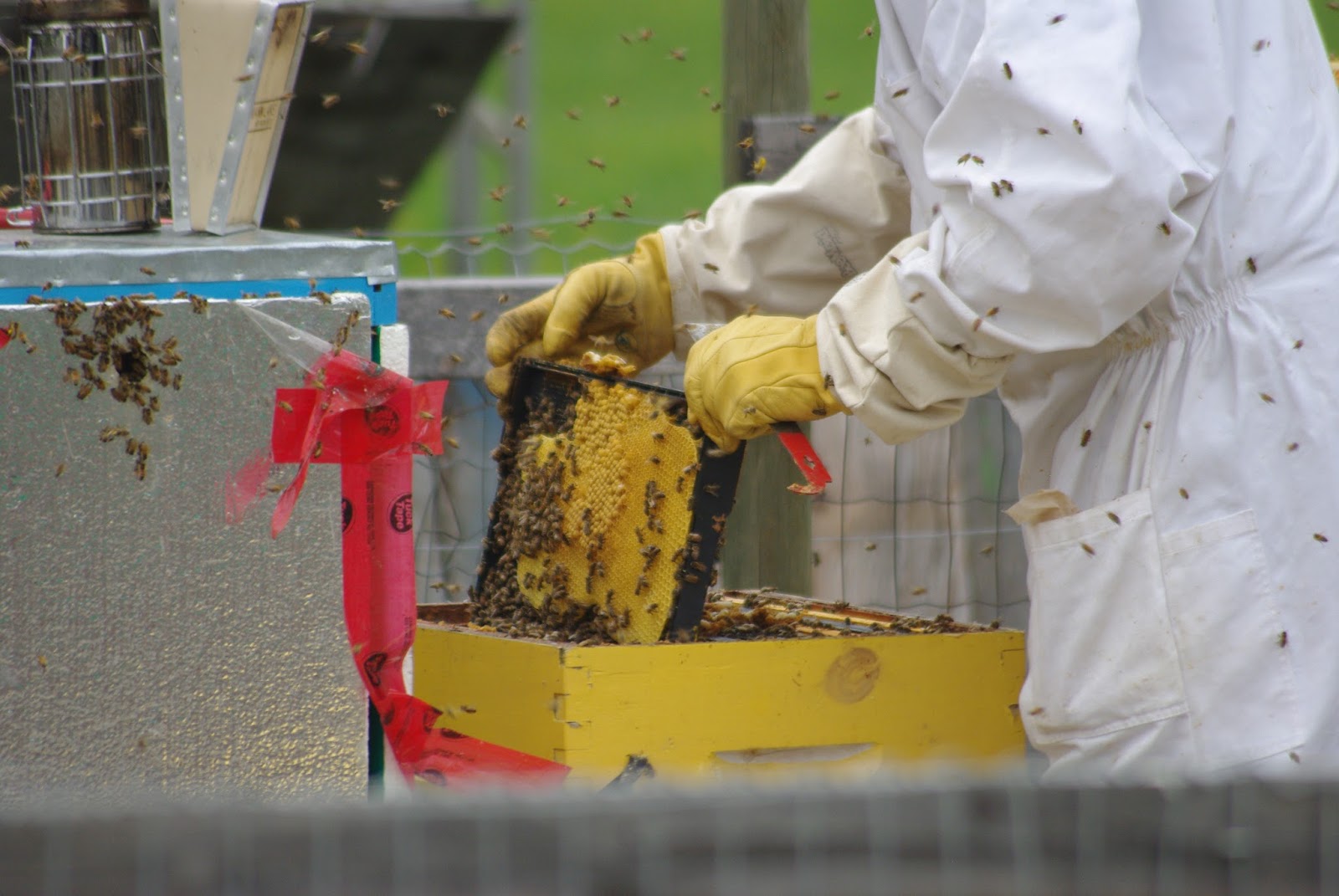
Before we add any queens, though, we have to prepare the hives, and split them. Each hive will already have a queen in it, and since we can't have two queens in a hive, we need to know where she is. To do this, we remove all the bees from the top box, brushing or shaking them off the frames, into the bottom box. If the queen is among them, she will also then be removed into the bottom box. Ideally we do this in the heat of the day, while the foraging bees are out working. Once the bees are all in the bottom box, we take some frames with brood out and move them into the top box. This will make the nurse bees want to be up there with them. We put in a 'queen excluder' -- a screen that allows the bees to go through but not the larger queen -- so that when we go to take that box off in 24 hours, there is a group of nurse bees, larva and eggs, all up there. That will be the basis of the new hive. We remove that box, set it up as the base unit on a new hive, drop in the queen, and we have our split complete.

The queen excluder.
Sounds easy, right? It probably would be, but then again, you have to remember we are dealing with some -- okay, millions of -- very protective, very determined little ladies here. We also have to check the hives before we do anything. We need to make sure they haven't started creating queen cells on their own -- a sign that they were getting ready to swarm. If they have, we may be able to use one of their own queens to start yet another hive. We don't want to add a queen to any new queen cells that are about to open. We also want to make sure the hive is healthy; there is no point dropping a new queen into a hive that is not going to survive. These are queens from Hawaii. They don't come cheap.

'Shaking' the frames. You can see the honey spraying off it.
When the splits are complete, we need to provide for the bees in the new hives for a few days. If we didn't, without foraging bees (because they would fly back to their original hive), the nurse bees would have nothing to live on, so syrup is a requirement at this point. When we did the splits, we also gave them some capped honey and pollen on the frames from the old hives, so they will be fine for a couple days while they all adjust and new bees hatch. Those new bees will soon be able to forage and the hive will thrive. We then will load up those new hives and take them to a new location; we will do this because these new hives will be a bit weaker and if conditions change, they could be overpowered by stronger bees from the original hives coming in and stealing from them. Our hives will be heading north about half an hour, where they will be able to help pollinate some fruit trees. Moving them also should mean that if something happens to harm the hives here again this year, as happened last year, we still have some bees to build from.

The queen excluder in place. The top box will sit on top it.
The bees that stay here will be unaffected by the change. They currently have plums, peaches, crabapples, pears, nectarines and apples all in bloom. The dandelions are out in abundance. The flowers are breaking through in the garden, and the holly trees are, apparently, abuzz with bees as they start to bloom. We have lots of drone cells in our hives, and they are all in good shape. The bee year is well underway. Hopefully these are the first of many splits over the next few months, and we will see lots of honey in the fall.
Bees don't like being shaken and split, so more smoke to calm them. 

Really full hives, and lots of drone cells! 

More indicators that the hives are doing well, and are very full! 

'Bearding' on the front. They are agitated and overcrowded in the bottom box. 

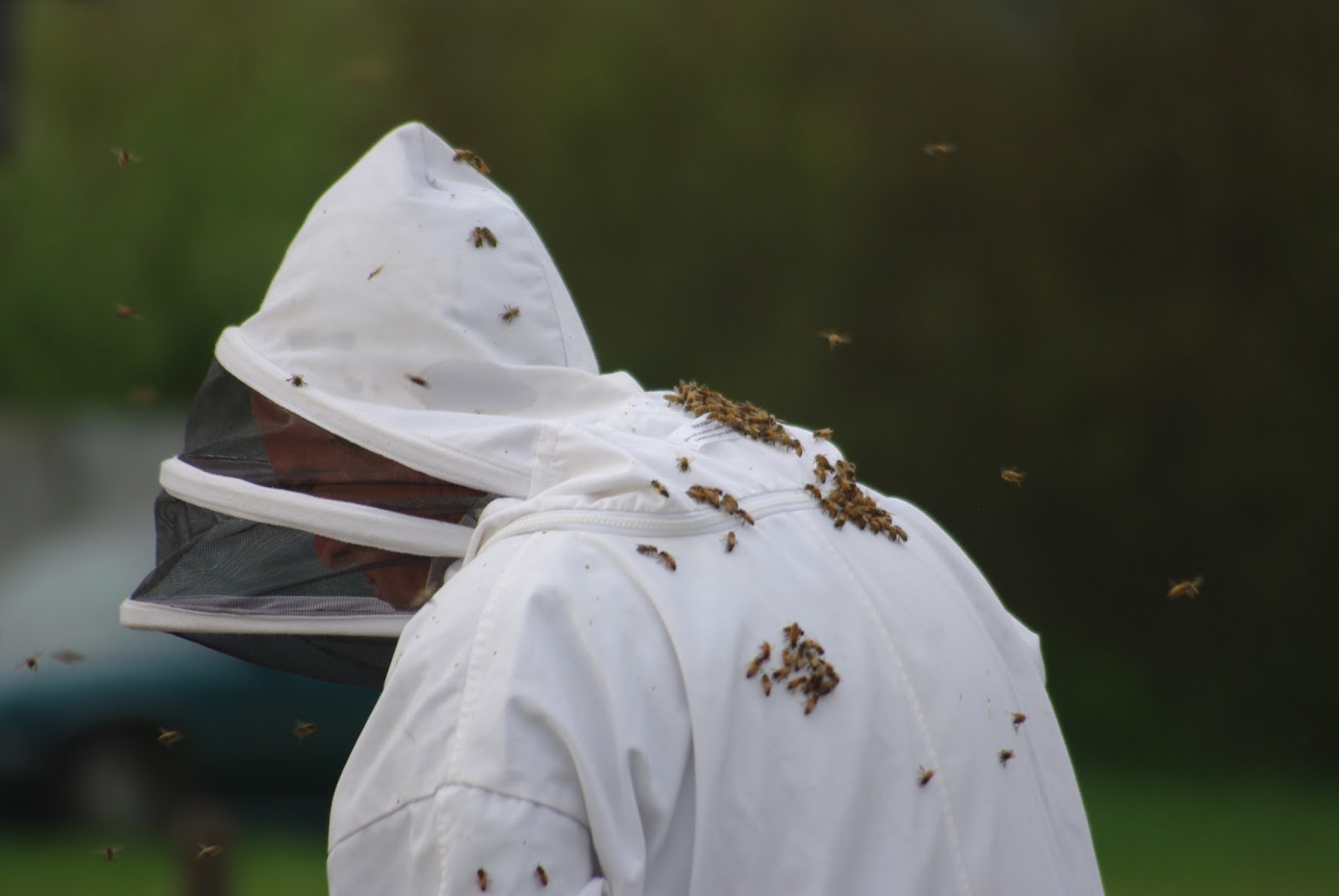
Yes, they even beard on us as we work. For this job, we want to wear full whites. 


Monday, March 28, 2016

Springing Forward

The swarm that started it all!
With the hope of ending 2016 a bit stronger than this last year (hopefully by tripling our hive count), this is the time of year when we have to do some planning. Of course, we plan the best way to split hives – there are a couple ways to do that. We plan the best strategy for watching out for and dealing with swarm cells, when the hives get too big and decide they want to make a new queen that will then take most of the young, strong bees to a new hive. Swarms are also a means for us to grow our yard, though, because when a swarm, either feral or from another bee yard does a surprise landing in some stranger’s back yard, we can go out and gather it up. It was a stray swarm landing in our yard four years ago that made us start this journey in the first place. We will be trying some ‘split hives’ where we put a divider right into the hive, like a bee condominium, with queens in each side. This allows them to keep the hive warm yet, and gives them a chance to get established without having to start completely from scratch. We will do a blog on this as we get into actually doing it.

Early hive activity 2016.
We have to plan on what purpose our bees will fulfill. They could strictly produce honey for us and this usually involves putting them into orchards and crops for the purpose of pollinating those crops. This is a very important part of having honey bees, and some would even argue that it is the only reason for having them. We could put pollen traps on the hives and gather the pollen for sale, because of the medicinal values. We could do likewise for propolis, which can be used in natural therapies. Some people raise bees simply in order to create more bees, breaking up the hives frequently and allowing those fragments to grow into full hives for sale, or for their own use. Queen rearing is a big business, and takes a special skill, because the queen cells are grafted into several dedicated frames, and are then caged and sold. There are even some apiasts who gather bee venom. Just about everything about bees can be used, so the options are many. Thankfully we don’t have to commit to just one thing, and can try our hand at several of them.

Another issue to make decisions on is where to put the primary bee yard. Right now, we have a small yard near the house, but if we are going to grow the number of hives, we also have to grow the area, then make sure it will be safe from any rather unwelcome guests, including (but not limited to) skunks, racoons, and bears. Since we have been spending the last few days refencing the property, we have been able to give this problem a bit more consideration, and believe we finally have a spot picked out for it. The next step will be to get it fenced and set up for moving the bees. Of course, not all of them will go to one spot in our yard. Hopefully we can find several other locations to set them out, allowing them to access more sources of pollen, and also to ensure that if something happens to one yard, we still have some bees to carry on with.

While it might be right that these plants are
protected from unwanted pests, they fail to
mention how deadly they are to pollinators.
Being avid gardeners at heart, we also need to consider what plants we want, and where we want them, to offer the best advantage to both the gardens and the bees. Some plants are just not what the bees want, while others can attract bees from miles away. Finding out which is which is a much more challenging undertaking than we thought it would be, because opinions differ greatly for many plants. Ideally we will avoid double-flowering plants – the ones that originally had just one layer of petals but now have been hybrid to the point of having two or even three layers of petals, making the flowers much fuller. By making them fluffier, it also makes them harder for the bees to find the pollen. We also must avoid any plants containing neonicotinoids. ‘Neonics’ are absolutely NOT bee friendly.


We also need to consider the flavors our plants will add to the honey. Some plants, like sunflowers, add no noticeable change to flavor but are an excellent source of pollen for bees (and the birds love the seeds all through the fall and winter). Others, like the blooms on the locust trees, add a wonderful flavor to the honey that is easily detected, and in some areas will add value to the finished product. We have a lot of locust trees on our property, and will soon have more, but we are also leaning toward planting more lavender. Alyssum, cosmos, and of course, dandelions are all plants that bees love, and that are vital to them. Planting some of these near the vegetable garden will ensure that all our plants are well pollinated and produce as much as possible – well, not the dandelions; the wind will take care of planting them all over the yard. It already looks like we are in for a bumper crop this year.


One of our bees on an apple blossom. 
The final consideration in choosing plants is blooming season. We want our bees to eat for as long as possible, but sometimes there are dry spells in a season where not much is happening, at least as far as flowers are concerned. Living in a rural community, we can count on the alfalfa and clover to provide for them throughout the summer and fall. We know that corn crops will do nothing, but berry crops will be wonderful in the spring. Of course, the orchards need bees, and our bees need fruit trees, so we have that one covered, at least for this year. We need to find plants, like primula, that will bloom early in the year, and some, like goldenrod, that bloom late. The value of the plants to the bees also will vary because of geographic location and anomalies, so it’s all a learning curve, but we’re more than happy to experiment to see what we like, and what our bees like.

It goes without saying that there are many more things to think about and plan for, like keeping the bees healthy, and the need for water, but at this time of year, these are the priorities in our bee yard.
BooBoo Bear was just a little guy last year, but even when little
these guys can do a lot of damage to a hive.