Showing posts with label winter. Show all posts

Sunday, January 15, 2017

Looking Ahead to 2017

Our hives in the new apiary, covered with snow but sitting
in the sunshine. 
It was a very busy fall for us. Our first priority for the fall was to move the bees to the new apiary. It has lots of room for growth, and we can park a trailer in there as well, which is the long term plan – then we can keep some bees on the trailer, and move them from orchard to orchard, getting that wonderful fruit pollen. It makes amazing honey. For the move, the hives were loaded up on the back of the truck, the tables were hauled over (we don’t like to have the hives directly on the ground because then they are just too inviting to bugs and critters who might have a hankering for some bees – yes, we mean skunks. They don’t care about the honey but they sure do love bees… and not in the good way.)

Taking the honey from the FlowHive
We also extracted our honey… lots of honey. When all was said and done, we ended up with about 1100 pounds of honey. If that sounds like a lot, you want to try to store it all in your kitchen pantry! Like all things, there was still some learning this year in the extraction department. We harvested our FlowHive for the first time, with mixed results – it was a very messy process! We also harvested 32 pucks of honey in the comb, and were very happy with that. With a little bit of that extracted honey, we did all our preserves and especially our jellies, using less than a cup of honey per batch instead of the many cups of sugar normally used, and it turned out wonderfully.

Moving the hives to the new apiary.
So, what about 2017? The hives are topped with snow, the bees are inside making sure the hive stays at the right temperature, and we are pondering the next honey season. As always, it seems, there are hive boxes and honey supers to be made. That is a never-ending task, it seems, as we grow. Since we hadn’t anticipated the growth we had last year, we used up every available box and frame, so there is work to be done there. We need to make our ‘shopping list’ of necessities – like queen excluders, calculating as best we can how many hives we will aim for next year. It’s hard to anticipate because so much depends on the winter. This winter has been very cold, unusually cold, with a lot of wind, so we could find that the hives are not as strong in the spring as we hoped. We also had a long fall, so they could have depleted a lot of their stores before the cold weather came. We also are over-wintering with single hives, instead of doubles, so there will be less stores for them to rely on inside.

Our honey in the comb, ready for sale. 
Without knowing what we have when we start the year, we almost require a couple of contingency plans. If the bees do well, and they are up and running strong early in the spring, we will have to decide if the focus will be on creating more hives, or creating honey, and if we go with creating honey, do we do more liquid honey or honey in the comb? We can also focus a bit more on gathering propolis and pollen instead of just honey, or we can decide to create hives to sell for other beekeepers, spreading diversity and helping new beekeepers get established. Regardless of what route we take, we know we have to re-queen the hives which raises the question of ‘growing’ our own queens or purchasing queens. We learned from last year that to purchase queen cells are much cheaper, but much more of a gamble. The growing of queen cells is an involved and intricate art, requiring a careful hand at the start when the harvest the day-old larvae, and absolute vigilance in monitoring and timing their growth to be able to move them appropriately at the right time. Being off even one day has dire consequences, so we need to be sure of what we’re doing and when we’re doing it. The learning curve on this task is, honestly, a bit intimidating, but the benefits, especially for our own hives, would be substantial.

University of Purdue -- growing queen cells. 
We have to look beyond these issues though, and consider what we do with what our bees produce. Selling hive nucs and queens are one way to make this gig pay, but are those enough or do they deplete our own ability to produce honey? We have been selling our honey, by the jar, by the puck and by the bucket, but is there more we can be doing? We have gathered a lot of beeswax over the last few years, so perhaps it’s time to find a use for that, something that will help to make this more than just an interesting hobby.


When you have angry bees because you have
just taken away all their honey, you have
to get creative when working outside.
Greg is geared up to do some welding,
while wearing a bee suit! 
So while we sit and ponder, and dream of sunshine and flowers for our bees, we will have more than enough to keep us busy (besides just making new hive boxes). We will pull out the aprons and the pots, and do some experimenting with the many wonderful by-products of bees, integrating the wax and hopefully the pollen and propolis, so more people can reap the benefits. At this point, at least for a few more weeks, the evenings will be spent reading and researching. The days inside the house will be spent testing and sampling. We’ll try to share some of the results as we go. It could be an interesting (and messy) journey. 

Sunday, March 6, 2016

Pollen, Pollen Everywhere

  
Almond orchards in California
We are learning that pollen is often available, even when one wouldn't expect it to be about. That's what makes this an interesting time of year for bees. We receive a lot of questions regarding what happens with bees when they want to get out of the hive, but they have no place to get pollen. In large part, the answer to that depends on the local climate in general, and the day-to-day conditions. In some areas of North America, primarily California where almost 7 million tons of almonds are grown annually, the bees have been working for weeks already, pollinating almond trees, a substantial task, and a bit of a juggling act for beekeepers in the US. The need for the bees is massive, requiring bees to be shipped from one coast to the other in order to provide enough bees to do the job. The problem becomes ‘what do they do with them when almonds are done but nothing else is ready for pollination’. For bees from naturally colder climates, this is not a small problem.


Bee on pussy willow
However, we are blessed, especially this year, with our moderate winter and early spring. The bees, at least ours, are never totally locked away. They always have access to get outside the hive. On warmer days, they will go out to do their business – it can be a long time for them to keep their little bee legs crossed. Sometimes they take flight and realize too late that they underestimated the temperature, and we see a number of dead bees on the snow around the hives. They got too chilled to make it back. Some days, we see the results of their cleaning around their hives, where they have already started to remove those who didn’t make it through the winter.


When the bees start winter, they form a mass in the center of the bottom of the hive. They use their wings to keep the temperature constant and to create heat – hard work in very cold weather. Their only purpose is to keep the queen protected and alive, and they will keep their wings moving 24 hours a day to that end. They do not hibernate. As the winter progresses, the mass will move up the hive, dictated by the food they have stored away. They need to have enough depth of hive and enough food stores to last them through the entire winter. Once they get to the top, you know they have run out of food, and it becomes time to feed them, which we do every spring.

Female bloom on hazelnut tree.
So it’s early March in the Okanagan. This year, our snow is gone. The temperatures are above normal. The bees are out and about... and to our great surprise and greater joy, they are already bringing in pollen... a LOT of pollen. There are no flowers, no grasses, no crops. There are no leaves on any of the trees yet, although the leaf buds are definitely swelling. So, where are they finding pollen?

Believe me, it’s there, but the flowers are so small, you really have to look for them. The first source for them is the wonderful, woolly pussy willows. Remember how, as kids, we would cut them and bring them in, the first true confirmation that winter has passed, spring was coming as promised, and life was going on? It’s understandable, but please remember, these little fluff balls are critical to bees early in the season, so leave some for them. This is the source of the deep yellow pollen they are packing into our hives right now.

Female hazelnut flower with male catkin in background

The second source would be hazelnut trees. Most people never notice the blooms on them... they are early in the year, when people aren’t looking for blooms on anything, but they are there. The hazelnut tree has both male and female flowers, the female being a very small star-like purple flower on the end of the bud. Hanging around these little ladies are long, thick catkin, about 8 inches long. In reality, the tree is NOT pollinated by bees at all. The plant is designed so that the wind does all the work, but there is so much pollen on the male catkins, that it is a true feast for the bees. The bees have absolutely nothing to do with the small, delicate female flowers. The catkins would be the source for the paler yellow pollen being stored away in our hives.


Hazelnut tree with catkins evident. 
Our search isn’t done. Today we saw they are bringing in bright red pollen. The search is on to find the source of that! The top of our suspect list is the weeping willow. 

Sunday, February 8, 2015

Taking Care of Beesness

We have talked about what bees do in winter in Canada, but what about the beekeepers? How do they spend the winter? While it’s not all work, there are still some critical things that need to be done.

First, because we need to be ready for spring, we build bee boxes for new hives. We have some new bees coming next year, but we also have to be ready for the hives that might want to split up, getting some into new hives before they swarm and we lose them. We will be adding 5 new hives in the spring, 3 packages from New Zealand, and 2 local nucs. We’ve done our homework, and have some of the best, oldest strain of bees coming – who knew bees had pedigrees? They aren’t as detailed as the American Kennel Club, but there is definitely some advantage to knowing a bit of the history of your bees.

Squaring up the boxes.
To make sure we have enough for this year – the five new ones and whatever splits we may get from the ones we already have – we created 24 boxes, so 12 new hives. We don’t expect that we will fill them all, but we can dream. It’s assembly line work to make them, but with all hands working, they’re stacked and ready to roll. We’ve decided that each year will be assigned a color, so we can keep track of when they arrived. This year, will be The Motley Blue. Each hive is a different shade, so hopefully we will be able to tell them apart.

Another thing we do in the winter is learn more about our bees. We want to start raising our own queens, so we have been studying that process. Next year we should have a lot more honey, so we need to figure out where we can sell it and how to promote it. To that end, we have spent the winter discussing (okay, arguing) about a name for our apiary. Suggestions are welcome!

While thinking about what to do with the honey, we have also done some product testing at home – we need to have some fun, right? We’ve made some mead, using our own honey, our very pure wonderful, natural water, and our own fruit. We spray nothing, and are far enough removed from spraying that we are very comfortable with all our produce being organic. We have made some plain honey mead, some raspberry honey mead, some blackberry honey mead, and some peach honey mead. This year was just small batches, so we can see how it tastes before we do anything more. It is already bottled, and needs to sit like that for several months before it will be ready. We’re also trying our hand at some honey lager beer. No kits or store bought shortcuts, though. We used hops, malted barley, and honey, sparged our wort, and soon it will be heading to the carboys to finish up. It should be wonderful for the summer.

The Motley Blue

We have been planning on something to do to help our bees as far as gardening. You may remember that we were originally avid gardeners. Now we want to have plants that will complement and accommodate the bees. We’re thinking lavender and clover. We won’t be putting in five acres of either, but we may start with a few hundred plants, just to see how it goes. We also will be looking at adding some monarda (bee balm) for the little ladies, and hopefully they’ll like the herbs we keep every year.

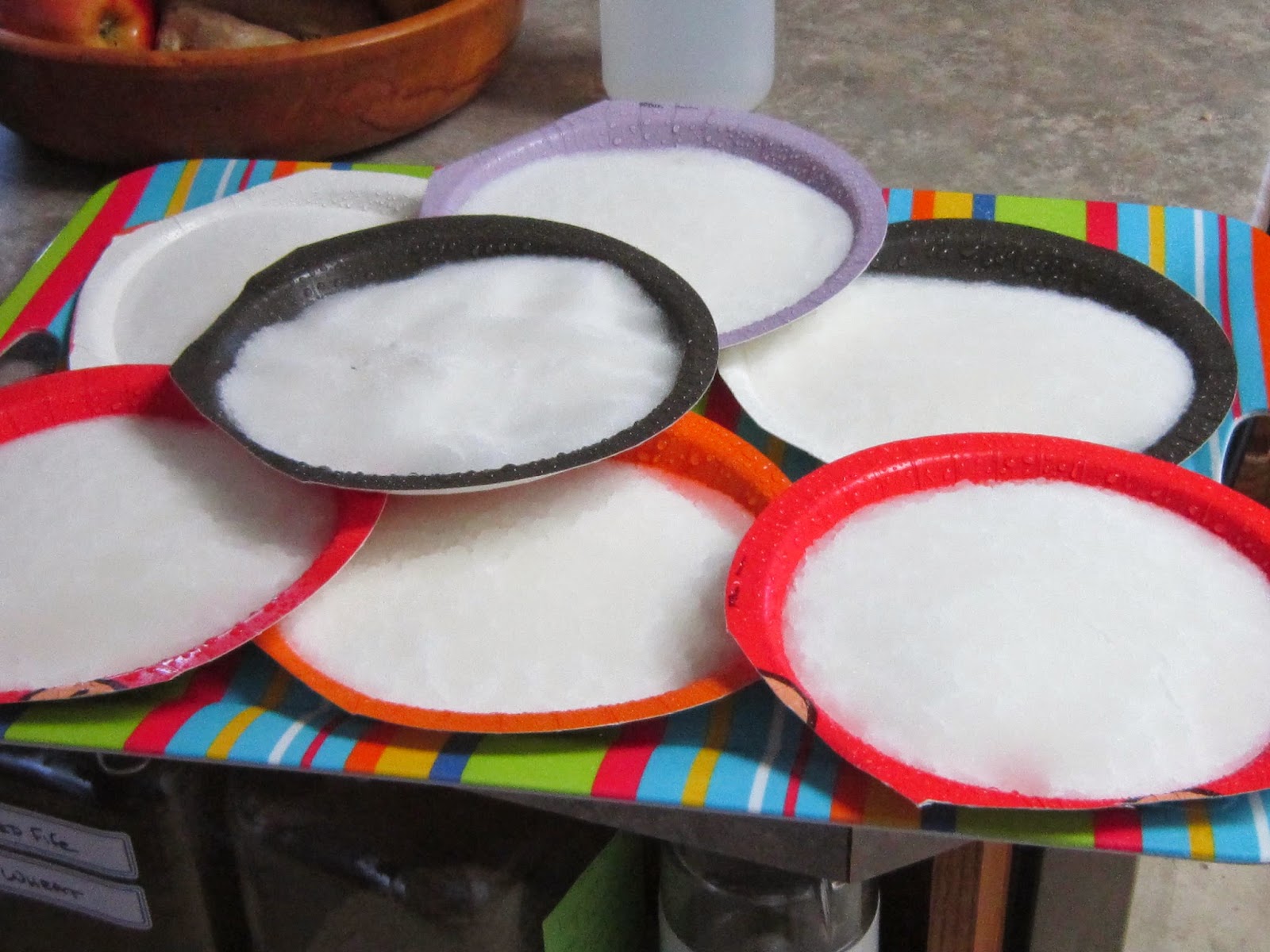
Plates of misted sugar.

We also still take care of the bees. This time of year can be tricky. They are starting to lay, starting to become active again, and their stored food could be growing sparse, so today we helped them out with plates of misted sugar – not sugar water, and not dry sugar, but misted so that it is sticky. If we had left it dry, they may think granules are dirt and set to work getting it out of there once the temperatures warm up some more. The sugar will also take on some of the humidity from the hive, and should hold them until temperatures are warm enough that we can put sugar water out for them. If course, once we reach summer, they don’t need us to give them anything in the hive; they want the entire inside for brood and honey. In a month from now, when we know that our temperatures are a bit more consistently warm, we will give them some protein patties, and let them get ready to bulk up and really get to work.

When we opened the hives today to put in the plates of misted sugar, we were able to see how our little bees were doing. They were very active today, flying around a lot. The Dregs, Gang Green and Pistachio were all doing well. There was some activity, and lots of bees taking flight. Moody Blue is a bit of a concern. We didn’t see any bees going in or out, and when we lifted it, there was very little activity. The White Outs, however, were crazy full and busy, creating comb and cleaning house. Because it is so full, the humidity is high and could be a problem. There was some mould around the edges, of the lid, so we cleaned out the doorways and hopefully they will get some air in there to dry it out a bit. Humidity is a much bigger problem than the cold is. Team Tangerine has been a concern for several months now, but it seems to be doing okay. It wasn’t nearly as full or active as the White Outs, but they are definitely holding their own. Mellow Yellow, as always, is going strong, lots of bees, lots of buzz, and hopefully this summer, lots of honey – barring issues again with humidity.
The White Outs! That's a LOT of bees! 

They're already going for the sugar. 

Mellow Yellow is also full to bursting. 

Giving sugar to the Gang Green.

Food for The Dregs. They're getting busy making honeycomb.
The Moody Blues. This one is a concern. We don't know where the bees have gone. 


Mellow Yellow has so many bees we had to push them aside to get the plate of sugar in there. 


Sunday, January 25, 2015

Hives of Activity


 Well, despite the fact that it’s January 25th, our hives are a-buzzing! We couldn’t be happier. We expected that we would have some loss – some of those hives weren’t particularly strong when we bundled them up for winter, we are noo-bees, and winter loss is just a fact of the business. We expected we may lose two or even three of our little apiary, but today, again, they are busy at work. We had to see what they were up to.
The first thing we noticed was that the bees jumped at the opportunity the warmer temperatures brought, and started their spring cleaning. As we have said before, they are incredibly clean animals, not wanting any dirt or debris in their hives. Over the course of the winter, for one reason or another, bees don’t survive, so the first job when cleaning is to push the dead bees out. It looks like a fairly big task, but after watching them kick the drones out – sometimes requiring three and four workers to force the male out of the hive – in the fall, the job is probably a bit easier. Then again, at this time of year, the bees are probably not as strong, being older, and being inside the hive for weeks at a time.

Pushing dead bees from the hive.
We’re thrilled that they are not just surviving the winter, but thriving through it. That doesn’t mean that we are out of the woods, though. We still have to get through February, which can be bitterly cold here, and we may even have to help them get through March, so we can’t party down quite yet.
The hives are alive and busy, which means the bees are eating. More than likely, the Queen has started to lay eggs again, putting more demand on food stores. Starvation at this time of year is always a concern. They’re working, and they could go through their food rather quickly. If we continue to have warm days, though, they could soon start to gather pollen. *waits a minute for the laughter to stop* Here in the Okanagan Valley in British Columbia, the bees have a ready supply of pollen they can collect any time of the year – pine trees. They are great pollen producers, and if our weather keeps warm like this, and we can make to 60F, our bees could easily slip into the tree belt and get a bit of a nosh to keep them going.

A return of the cold weather could also give another opportunity to mites and disease, as the bees gather tightly together in the middle of the hive. As mentioned in earlier blogs, humidity in the hives is also a concern if the temperatures drop. The cluster of bees can maintain a temperature of 92F, but as they work to maintain that temperature, they sweat. Just like humans, when we consume food to live, we also give off solid and liquid waste. For bees, that moisture – respiration – rises to the top of the hive. If the temperature is below freezing outside, and the moisture collects, and the hives are not properly insulated, ice will form and block the bees from getting to the food. Our special tops on the hives help to stop this by having extra ventilation to allow the moisture to escape, and by having materials that will soak up the moisture without dropping it back down on the bees. That doesn’t mean it can’t happen though, so we still must be vigilant to keep them protected.


Yes, today we opened a hive. It’s cold, and we don’t want to let that cold air in, but we believed the hive had not survived. It was a wonderful surprise to find them alive and happy, and very busy. There’s still more winter to get through, but we’re feeling very blessed today, and are looking forward to getting back into the groove with our 150,000ish little ladies. 

Saturday, January 24, 2015

But BaBee It's Cold Outside


Bees in winter, you say? Why yes, on nice days, we do see our honey bees, even when there is snow on the ground.

Honey bees do not hibernate; even though they are, for the most part, out of sight tucked away warm and snug in their hives. Even here in cold, frozen Canada, honey bees do not hibernate. They don’t even take long naps like squirrels do. Bees work in winter. They work to stay warm, and that takes a lot of energy.

As we mentioned in our earlier blog, one of the things bees do to prepare for winter is to evict all the drones/males. Males don’t do anything in the hive. They don’t protect the hive, they don’t help with the production of honey. They are there for the sole purpose of breeding queens (but not the queen in their own hive). Queens only breed at one time in their lives but they will breed with as many as twenty different drones on that mating flight. She then returns to her hive and begins to lay her eggs. When there is a need, she will create some drone eggs, but otherwise all the eggs she lays will be females which will do the work to maintain the hive.

The eggs will progress to larvae which will be capped over by the workers. They then enter a pre-pupal and pupal stage before becoming a bee. This process will take 21 days for a worker bee, 16 days for a queen, and 24 days for a drone. For the first three weeks of their lives, worker bees will work in the hive. For the last three weeks of their lives, they are field bees, collecting pollen. (However, if you were to remove one class of bees – hive bees or field bees – completely from the hive, the other class moves in and takes over the work so that the hive survives).

All of this changes, though, come fall. The queen slows, then temporarily stops, laying eggs while the hive prepares for the winter months. They have put extra stores of honey and pollen away, and the hive uses these stores to survive throughout the winter and into spring until the temperatures are warm enough outside to start production again. Where summer bees generally live six weeks, winter bees have to survive throughout the winter, so they will live up to six months or even longer.

So what do these bees do during the winter? The sole goal of a bee is to help the hive survive. That’s what they do in the winter. They gather together, low in the center of the hive, and they generate heat to keep themselves warm. It’s amazing how much heat they can generate. As the winter progresses, and because heat moves up, the core of bees will move up the hive, consuming the food they put away. The stores at the top of the hive will be eaten last. The bigger problem in the hive, as opposed to heat, is humidity. It can, in essence, rain inside the hive, and that’s bad. For this purpose, we have special covers for the hive that include a layer of wood chips to help absorb the moisture, preventing it from condensing and falling onto the bees.


What they don’t do, though, is poop in their hives. Bees are fastidiously clean, so on those warm days, they leave the hive to take care of business. Even with the several feet of snow we have on the ground, the bees will come out. Unfortunately not all bees make it back to the hive. Inside the hive, though, because they are in confined spaces for long times, disease and mites can be a problem. Ordinarily bees can come and go and a sick bee is quickly replaced. In winter, the diseases and mites can get a better grip on them and can take a toll. In the fall, while preparing for winter, we help by doing treatments for these problems to help prevent or lessen the impact, but that doesn’t always work. The bees, the temperatures the length and intensity of the winter will all play a role, but seeing bee come out at this time of year gives us that much more hope that they were properly prepared, and will be more than ready to start production soon. There is nothing like the hum of a beehive in winter to remind you about how amazing these little critters are.